





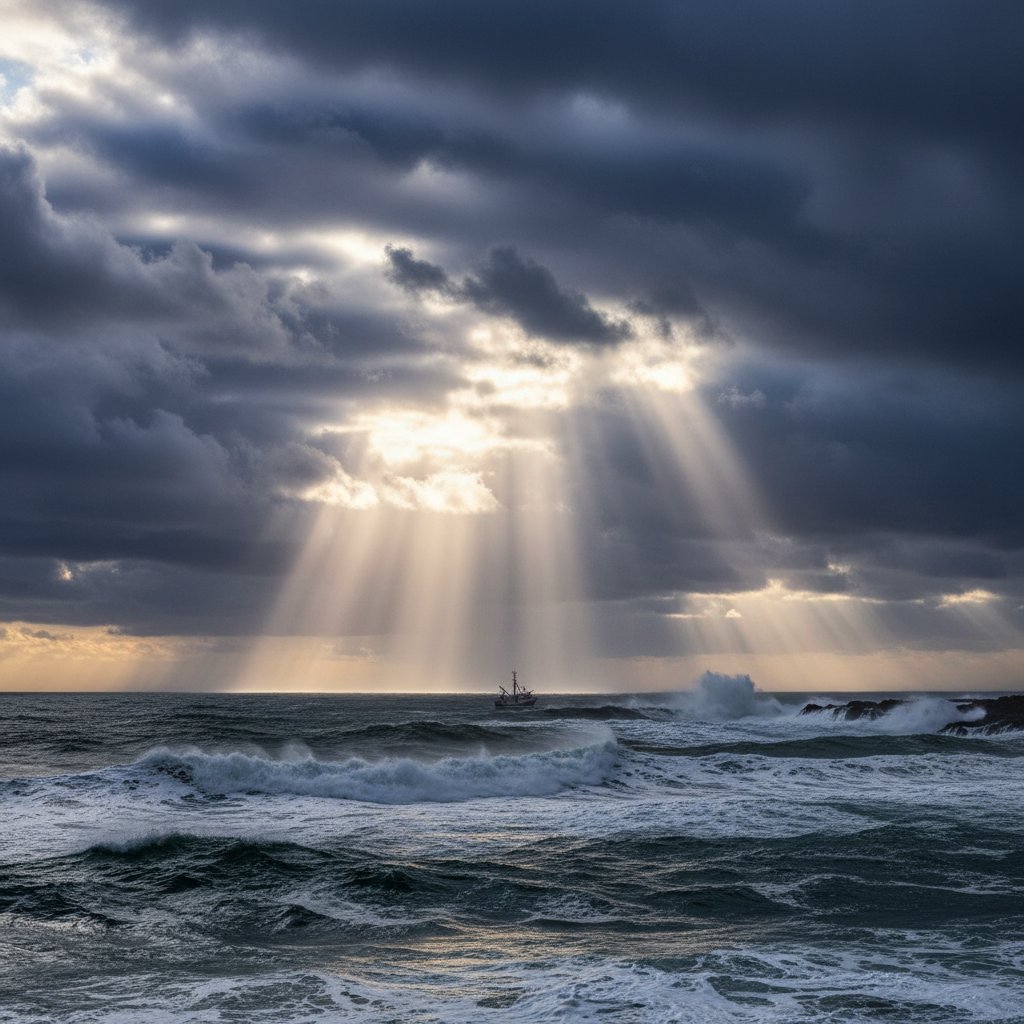
You’re standing on a beach in Portugal, staring out across the Atlantic. The sky is a mess of gray and blue, clouds stacked like dirty dishes. Then—a crack of light. It slices through the cloud cover, a golden shaft that hits the water like a spotlight. Another follows. Then another. The ocean lights up in streaks, as if someone’s pulled back a curtain on heaven.
These are crepuscular rays—or, as they’re more poetically known, God rays. And in the Atlantic, they’re not just beautiful. They’re a sign of something deeper happening in the atmosphere. A message, if you will, written in light.
Look, I’ve covered weather for two decades. I’ve chased tornadoes, stood in hurricane eyewalls, and baked under Europe’s deadly heatwaves. But I’ve never seen anything quite like the way these rays dance across the open ocean. They’re fleeting. They’re magical. And they’re telling us a story about the air we breathe.
The Physics of a Prayer
Crepuscular rays are, at their core, an illusion. They appear to radiate from the sun like spokes on a wheel, but really they’re just parallel beams of sunlight passing through gaps in clouds. When those beams hit particles in the atmosphere—dust, water droplets, pollution—they scatter, creating the visible columns. The same effect that makes a sunset orange makes God rays possible.
“Think of it as nature’s laser show,” says Dr. Elena Marchetti, an atmospheric physicist at the University of Lisbon. “The rays are most dramatic when the air is loaded with aerosols—dust from the Sahara, sea salt, even volcanic ash. The Atlantic, especially near the African coast, is a prime spot.” Indeed, the Saharan Air Layer—a massive plume of dust that drifts westward over the ocean every summer—acts like a canvas for these light shows. Saharan dust could add an apocalyptic hue to Europe’s unrelenting heat, but over the open Atlantic, it creates something ethereal.
So when you see those beams slashing down, you’re looking at dust. Dust that blew off the Sahara last week, maybe from a storm in Mali or a dry spell in Morocco. That dust makes the rays visible—and it also makes the sky hazy, the heat more oppressive. It’s beautiful, and it’s a little terrifying.
Stories from the Water
I reached out to Captain James Rutledge, a merchant marine who’s spent 30 years crossing the Atlantic. He’s seen God rays a hundred times, but he remembers the first one vividly.
“I was a rookie, on a cargo ship headed from Rotterdam to Baltimore. We hit a patch of weather—low pressure, scattered cumulus. Around 5 PM, the sun broke through, and these beams just erupted. The deck crew stopped working. Everyone stared. It felt like a blessing.”
But for some, the rays carry a warning. “When you see them spreading out from a cumulonimbus cloud, especially in the afternoon, that’s a sign of instability,” says Rutledge. “It means the atmosphere is cooking. Thunderstorms are brewing.” He’s not wrong. In the tropics, strong crepuscular rays often precede squalls—lines of intense rain and wind that can catch a sailor off guard.
On the other end of the spectrum, there’s Maria Santos, a marine biologist who studies phytoplankton off the Azores. For her, God rays are a tool. “The light penetration changes plankton distribution. I’ve observed higher concentrations of photosynthetic organisms right where the beams hit the water. It’s as if the ray is feeding the ocean.” Her research suggests that these scattered shafts of light might actually boost primary productivity in small patches. A ray of life, literally.
What It Means for You
If you’re planning a trip to the Atlantic coast this summer—say, a ferry from Spain to the Canary Islands, or a cruise past Bermuda—keep an eye on the sky. God rays are most common in late afternoon when the sun is low and clouds are scattered. The best viewing spots? The US East Coast, the Gulf of Mexico, and the Mediterranean. But the real magic happens over the open ocean, where no city lights compete.
There’s also a practical side: the same atmospheric conditions that produce stunning crepuscular rays can also trap heat and worsen air quality. The dust that makes the rays visible is the same dust that strengthens heat domes. Traveling to Europe in a heat wave? Essential safety tips for 2025 include staying indoors during peak ray hours—not because the beams are dangerous, but because the heat behind them is.
According to Dr. Wei Zhang, a meteorologist at the University of Miami who studies aerosol-cloud interactions, “Crepuscular rays are a visual indicator of how much suspended material is in the air. In a warming world, we’re seeing more Saharan dust outbreaks, more wildfire smoke crossing oceans. Those events produce less vivid rays—shallower angles, muted colors. But they also signal larger climate shifts.” Zhang’s team uses satellite data to map ray frequency as a proxy for aerosol loading. “It’s not a perfect metric, but it’s a beautiful one.”
The Next Chapter
So what’s coming? As the Atlantic warms and storm tracks shift, the dance of light over the waves will change too. We may see fewer classic God rays in the North Atlantic, where cloud cover is becoming more uniform. Meanwhile, the subtropical regions—the horse latitudes around 30° north—could see more. The same latitudes where the Bermuda high parks itself, where the air is dry and the sun is fierce.
I think about the sailors who once called these rays “the ladder to heaven.” They didn’t know the physics. They just knew that sometimes, when the wind dies and the sky clears, the ocean itself seems to glow. That’s a story worth telling.
Frequently Asked Questions
Are crepuscular rays the same as anticrepuscular rays?
No—but they’re related. Crepuscular rays appear to radiate from the sun’s position. Anticrepuscular rays, much rarer, appear on the opposite side of the sky and seem to converge at the antisolar point. Both are caused by the same parallel beams, just viewed from different perspectives.
Can God rays be dangerous?
Not directly, but they often form in hazy, dusty air that can aggravate respiratory conditions. Also, if you see them spreading from a thunderstorm, it’s a sign of strong updrafts—so stay out of the water or seek shelter.
Where is the best place to see God rays over the Atlantic?
Anywhere with low clouds and a clear horizon. Top spots include the Azores, Bermuda, the Canary Islands, and coastal Portugal. Mid-afternoon in summer provides the most dramatic displays, especially after a passing shower.