

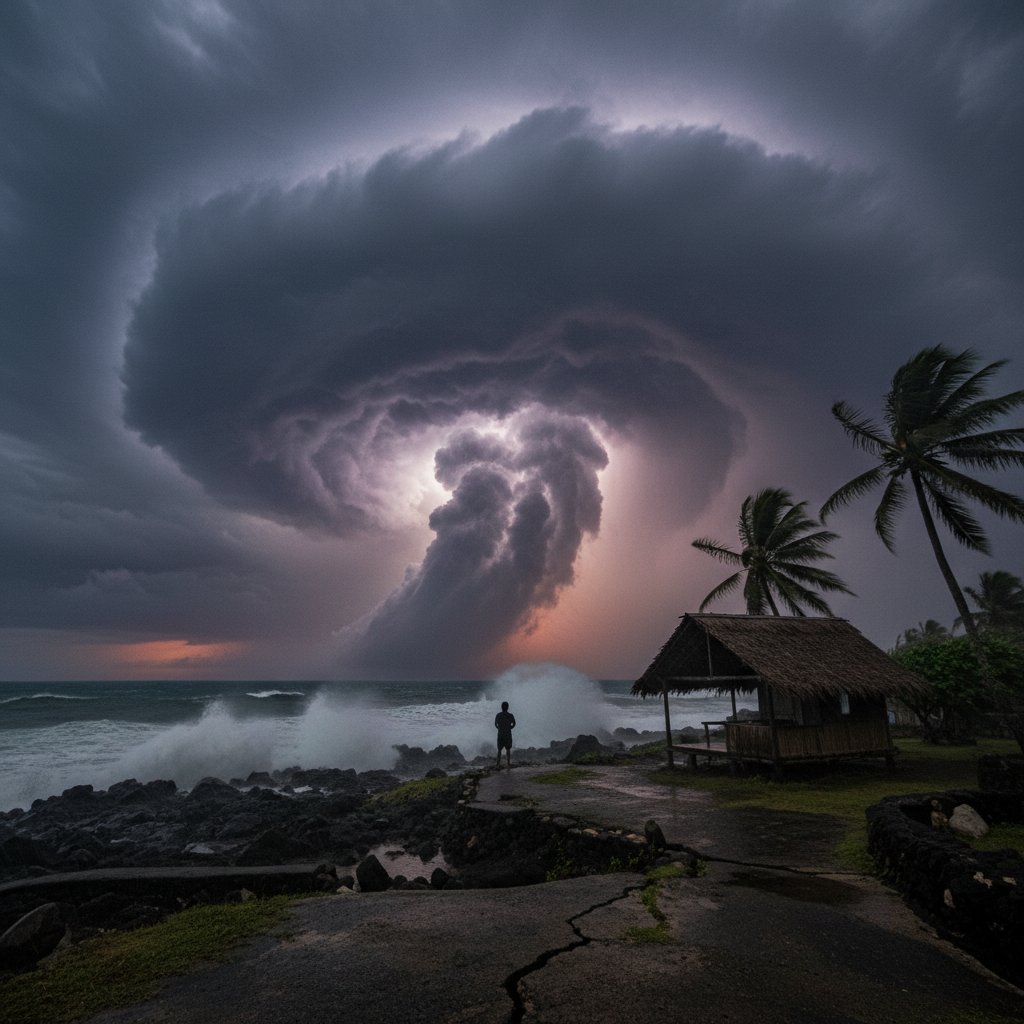
I remember standing on a beach in American Samoa a few years back, watching the sunrise over the Pacific. The water was glassy, the air thick with humidity. A local fisherman told me, “The ocean is beautiful, but she never forgets.” He meant the tsunami of 2009, the one that killed nearly 200 people across the Samoan islands. So when I saw the alert this morning — 5.1 magnitude, Samoa Islands region, 07:11 UTC — my stomach dropped. Not because 5.1 is huge. It isn’t. But because in this part of the world, every tremor carries a memory.
The quake struck at a depth of roughly 30 kilometers, according to initial data from the USGS Earthquake Hazards Program. It was centered about 200 kilometers south of Apia, the capital of Samoa. No tsunami warning was issued by the Pacific Tsunami Warning Center. No immediate reports of damage or injuries. On paper, it was a routine seismic event — the kind that happens hundreds of times a year along the Ring of Fire.
But routine doesn’t mean trivial. And for the 200,000 people living across Samoa and American Samoa, a 5.1 is a wake-up call. It’s the kind of quake that rattles shelves, wakes children, and sends a collective breath-hold across the islands. Is this the one? Is the water going to pull back? Those questions never fully fade.
Why This Quake Matters – Even If It Didn’t Break Anything
Let’s be clear: a 5.1 is not a disaster. Buildings in Samoa are built to withstand stronger shaking. The islands sit on the boundary of the Pacific and Australian plates — a subduction zone that regularly produces magnitude 6 and 7 events. The 2009 tsunami was triggered by an 8.1 quake near Tonga. So a 5.1 is small potatoes.
But here’s the thing about the Ring of Fire: it doesn’t send warnings. Small quakes can be foreshocks. Or not. The National Oceanic and Atmospheric Administration’s tsunami.gov site shows that since 1900, there have been over 20 tsunamis in the Samoa region, several deadly. So when the ground shakes, people pay attention.
“Every earthquake in the Pacific is a reminder that the plate boundary is active,” says Dr. Sarah Thompson, a seismologist at the USGS Pacific Coastal and Marine Science Center. “A 5.1 is a moderate event, but it’s also a teaching moment. It tells us the stress is still building. The system is alive.”
And that’s the real story. Not the shaking — but the waiting. The uncertainty. For residents of the Samoan islands, each quake is a tiny stress test of their emergency systems, their building codes, their evacuation routes. And those systems matter more than ever in a year when extreme weather events — from Europe’s brutal heat wave to the quiet, deadly toll of extreme heat in America — are already stretching global disaster response.
“We sometimes forget that the Pacific Islands are on the front line of multiple hazards — earthquakes, tsunamis, cyclones, sea-level rise. A 5.1 is a reminder that the ground beneath our feet is never truly still.” — Dr. Mark Rivera, disaster risk reduction specialist, Pacific Islands Forum
What Makes the Samoa Region So Seismically Active?
To understand why this quake happened, you have to look at the map. The Samoa Islands sit smack in the middle of the Pacific Ring of Fire — a 40,000-kilometer horseshoe of tectonic collisions and volcanic activity that wraps around the Pacific Ocean. Here, the Pacific Plate dives beneath the Australian Plate at a rate of about 80 millimeters per year. That’s roughly the speed your fingernails grow.
But that slow, steady movement isn’t smooth. The plates stick, build stress, and then release it in bursts — earthquakes. The subduction zone near Tonga and Samoa is one of the most seismically active on Earth. In 2017, a magnitude 6.5 struck the same area. In 2019, a 6.3. The 2009 tsunami remains the deadliest natural disaster in modern Samoan history.
“The Tonga Trench is a factory for large earthquakes,” explains Dr. Thompson. “We monitor it constantly, but we can’t predict when the next big one will come. What we can do is make sure communities are ready.”
And readiness is a mixed bag. American Samoa, a U.S. territory, benefits from NOAA‘s tsunami warning system and federal disaster funding. Independent Samoa relies on its own resources and international aid. Both have improved evacuation drills and early warning networks since 2009. But small island states face unique challenges: limited budgets, remote communities, and the constant pressure of climate change — which, as this piece on America’s deadliest weather threat points out, can compound the risks from seismic events by eroding coastlines and damaging infrastructure.
What Happens Next?
For now, the Samoa Islands can breathe easy. The 5.1 didn’t trigger a tsunami. No reports of landslides or structural damage. Life goes on — fishermen go out, kids go to school, tourists post Instagram photos of To-Sua Ocean Trench.
But seismologists are watching. The quake occurred near a segment of the subduction zone that hasn’t ruptured in a major way since 1917. That means the stress is still there, building. A 5.1 is like a single crackle in a campfire — it doesn’t mean the fire is going out.
“We see clusters of moderate earthquakes sometimes before a larger event,” says Dr. Rivera. “But we also see them with no follow-up. The only honest answer is: we don’t know. That’s why preparedness is not a one-time drill. It’s a culture.”
And that culture is being tested more frequently. As global temperatures rise and weather patterns destabilize, the intersection of geophysical and climate hazards becomes more dangerous. A tsunami after a cyclone. An earthquake during a heat wave. The Pacific Islands are living laboratories of this compound risk.
So when you hear about a 5.1 in Samoa — and you will, because there will be more — don’t dismiss it. It’s not a disaster. But it’s a whisper from the Earth. A reminder that the ground we build our lives on is never quite solid. And that in the Ring of Fire, the story is never over.
Frequently Asked Questions
Is a 5.1 magnitude earthquake dangerous?
Generally, a 5.1 earthquake is considered moderate. It can cause light damage to poorly constructed buildings and may rattle items off shelves, but it rarely causes significant structural damage in areas with modern building codes. In the Samoa Islands, where many structures are designed to withstand stronger shaking, the risk is low. However, the psychological impact and the reminder of tsunami risk are important.
Could this earthquake trigger a tsunami?
No tsunami warning was issued for this event. Tsunami generation typically requires earthquakes of magnitude 7.0 or higher, especially in subduction zones, and a shallow depth. A 5.1 at 30 km depth is unlikely to displace enough water to create a dangerous wave. Still, local authorities always monitor for any unusual sea-level changes.
How common are earthquakes in Samoa?
Very common. The Samoa Islands lie along the Pacific Ring of Fire, one of the most seismically active regions on Earth. Small to moderate earthquakes (magnitude 4–6) occur several times a year. Larger earthquakes (magnitude 7+) happen a few times per century. The most devastating recent event was the 2009 magnitude 8.1 earthquake that generated a deadly tsunami.