




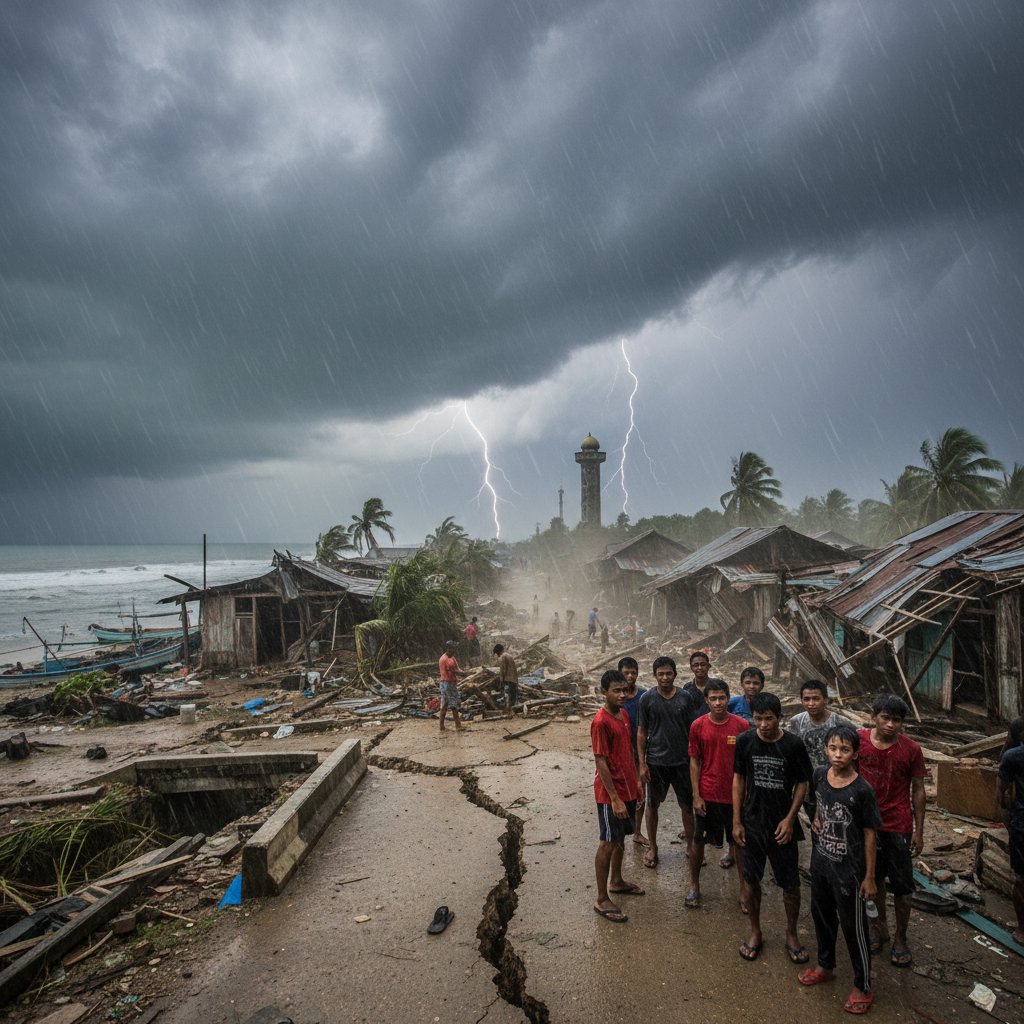
When you think of Indonesia, you probably picture tropical beaches, lush rainforests, and maybe a volcano or two. But what’s actually happening beneath those idyllic islands is a relentless geological reality: the Pacific Ring of Fire is always active, and Halmahera just got a sharp reminder. At 12:13 UTC on [current date], a magnitude 5.1 earthquake struck the region, sending tremors through communities already accustomed to the ground shifting beneath their feet.
The quake’s epicenter was located at coordinates 1.23°N, 127.89°E, roughly 45 kilometers northwest of the city of Tobelo on Halmahera Island. The depth was measured at approximately 35 kilometers — shallow enough to be felt strongly but deep enough to avoid the catastrophic surface rupture that shallower quakes can trigger. The Indonesian Agency for Meteorology, Climatology, and Geophysics (BMKG) reported no immediate tsunami threat, which is the first piece of good news for residents along the coast.
But let’s be clear: a 5.1 is not a minor event. It’s enough to knock items off shelves, crack plaster, and send people running for doorways. In a region where building codes aren’t always enforced to Western standards, even moderate shaking can cause structural damage. And Halmahera sits in a complex tectonic zone where the Philippine Sea Plate, the Pacific Plate, and the Indo-Australian Plate all collide. This isn’t a one-off — it’s a pattern.
The Tectonic Reality of Halmahera
Halmahera is part of the Maluku Islands, a region that’s historically been a hotbed for seismic activity. The island itself is shaped like a strange, contorted K — a product of millions of years of plate collisions. The Molucca Sea to the west is one of the most seismically active zones on Earth, with double subduction systems that create a constant drumbeat of earthquakes.
According to the US Geological Survey, the region has experienced over 200 earthquakes of magnitude 4.5 or greater in the past decade alone. The 5.1 event on [current date] fits squarely into that pattern. But here’s the thing: while a 5.1 is moderate, it’s the shallow depth that makes it dangerous. Shallow quakes — anything above 70 kilometers — transfer more energy to the surface. That’s why this one was felt as far away as Ternate and even parts of Sulawesi’s northern tip.
Dr. Rina Kusumawardhani, a seismologist at the Bandung Institute of Technology, explains: “The Halmahera region is essentially a tectonic pressure cooker. The plates are converging at a rate of about 10 centimeters per year. That’s fast in geological terms. Every time we see a 5.0 or higher, it’s a release of stress that’s been building for years. But we can’t predict when the next big one will come.”
And that’s the uncomfortable truth. Indonesia has been hit by devastating quakes before — the 2004 Sumatra-Andaman earthquake (M9.1) and the 2018 Lombok sequence come to mind. Halmahera itself saw a deadly 7.0 in 2019 that triggered landslides and killed dozens. So while this 5.1 is a reminder, it’s also a warning.
What This Means for Residents and Travelers
For the roughly 450,000 people living on Halmahera, earthquakes are part of life. But that doesn’t mean they’re prepared. Many homes are built from wood and corrugated metal — materials that don’t hold up well to shaking. The BMKG has issued advisories urging residents to check for cracks in walls and to avoid buildings that may have been weakened.
Travelers in the region — and there are some, drawn to Halmahera’s diving spots and untouched beaches — should take note. The island isn’t a major tourist hub like Bali, but it’s gaining attention. If you’re there, know your evacuation routes. And don’t rely on your phone’s emergency alerts; cell service can be spotty in rural areas.
This earthquake also comes at a time when extreme weather events are dominating headlines elsewhere. While Halmahera shakes, Europe swelters in an extreme heat wave, and parts of the US are dealing with storm-driven car accidents and their legal fallout. It’s a reminder that natural hazards don’t take turns — they hit simultaneously, across the globe.
Dr. James Thornton, a disaster risk reduction specialist at the University of Auckland, adds: “We tend to compartmentalize disasters — heat waves here, earthquakes there. But the reality is that climate change and tectonic activity are both increasing the vulnerability of populations. A moderate earthquake in a poorly prepared area can be just as deadly as a major one in a well-built city.”
Historical Context: Halmahera’s Seismic Memory
To understand this quake, you have to look back. In 2019, a magnitude 7.0 earthquake struck near the island of Ternate, just west of Halmahera. That event triggered landslides that buried villages and killed at least 50 people. The 5.1 we just saw is smaller by orders of magnitude — but it’s happening in the same fault system.
The region’s seismic history is written in the rocks. The Halmahera Arc is a volcanic island arc, meaning it’s formed by the subduction of one plate beneath another. That process creates volcanoes — and earthquakes. The arc includes active volcanoes like Mount Gamalama on Ternate, which erupted as recently as 2018. So when the ground shakes, it’s not just tectonic stress; it’s the entire geological system flexing.
What’s concerning is the frequency. Since January 2024, the BMKG has recorded over 30 earthquakes of magnitude 4.0 or higher in the Halmahera region. That’s above the long-term average. Some seismologists worry that this could be a precursor to a larger event — though they’re quick to caution that earthquake prediction is still an inexact science.
Look, I’ve covered earthquakes from California to Japan to New Zealand. And one thing I’ve learned: the public tends to underestimate moderate quakes. A 5.1 doesn’t make the global news cycle like an 8.0 does. But for the people in Tobelo who felt their houses sway and heard the rumble, it’s a very real event. It’s a reminder that the ground is never truly still.
What Comes Next
In the immediate aftermath, the focus is on aftershocks. The BMKG has warned that smaller tremors — in the 3.0 to 4.5 range — are likely in the coming days and weeks. Most will go unnoticed, but some could be felt. Residents should stay vigilant, especially near steep slopes where loose soil could give way.
Longer term, this earthquake should push for better building standards in eastern Indonesia. The government has made strides since the 2004 tsunami, but enforcement remains weak in remote areas. International aid organizations have been working on community-based disaster preparedness, but funding is always an issue.
And here’s the forward-looking piece: as global temperatures rise, the intersection of geological and climate hazards becomes more dangerous. A heat wave can weaken infrastructure, making it more vulnerable to shaking. Floods can trigger landslides in earthquake-prone areas. We’re seeing this play out in real time — and it’s not going to stop.
For now, Halmahera breathes. The shaking has stopped. But the plates are still moving. And somewhere beneath the Molucca Sea, stress is building again.
Frequently Asked Questions
Was this earthquake related to volcanic activity on Halmahera?
Not directly. While Halmahera is part of a volcanic arc, this particular earthquake was caused by tectonic plate movement, not magma movement. However, the same subduction zone that creates volcanoes also generates earthquakes, so they are connected in a broader geological sense.
Should travelers cancel trips to Halmahera after this earthquake?
No, not necessarily. A magnitude 5.1 earthquake is moderate and did not cause widespread damage. However, travelers should monitor BMKG advisories, check for aftershocks, and ensure their accommodations meet basic safety standards. It’s always wise to have an emergency plan when visiting seismically active regions.
How does this earthquake compare to the 2019 Ternate earthquake?
The 2019 Ternate earthquake was a magnitude 7.0 — about 500 times more energy release than a 5.1. That quake caused significant damage and loss of life. This event is much smaller and is considered a routine occurrence in the region. Still, any earthquake in a populated area warrants attention.