




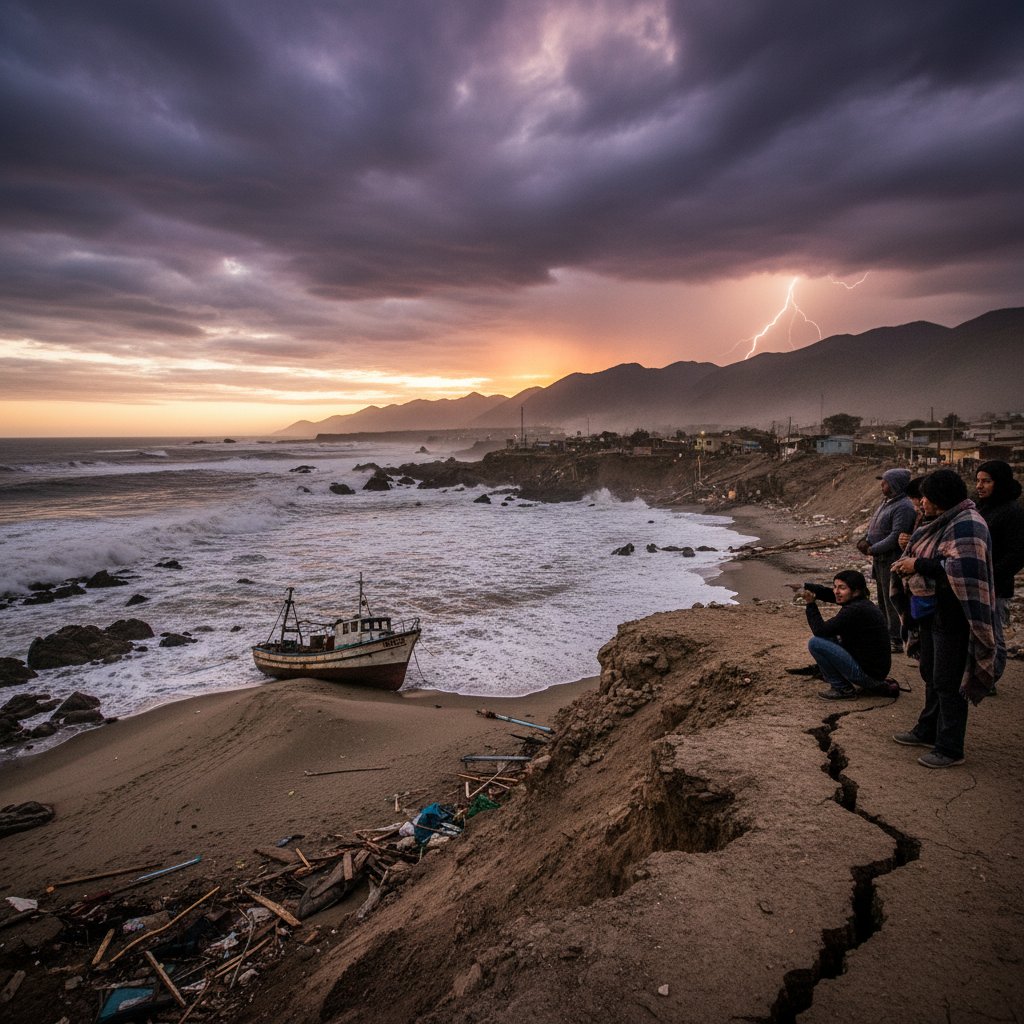
At 1:19 AM local time, a magnitude 5.0 earthquake struck near the coast of northern Chile, sending a jolt through communities accustomed to living on the edge of tectonic instability. The tremor, registered at 05:19 UTC, originated about 45 kilometers offshore from the Antofagasta region, a stretch of the Pacific Ring of Fire that has borne witness to some of history’s most powerful seismic events. While no immediate reports of casualties or major structural damage have emerged, the quake serves as a visceral reminder of the raw geological forces that underpin daily life in this slender South American nation.
Chile is no stranger to earthquakes. In fact, the country holds the record for the largest earthquake ever instrumentally recorded—the 1960 Valdivia earthquake, a staggering M9.5. Since then, the nation has built a culture of preparedness that is among the most advanced in the world. Yet every tremor, no matter how moderate, tests that resilience and stirs collective memory.
A Region Forged by Tremors
The Nazca Plate and the South American Plate grind together along the Chilean trench at a rate of several centimeters per year. This relentless convergence is the engine behind the region’s frequent seismicity. Northern Chile, including the area near the epicenter, is particularly active. The M5.0 event is considered a moderate earthquake, but in many other parts of the world it would be notable.
“An M5.0 earthquake in this part of Chile is a routine event, but it doesn’t mean it’s insignificant,” said Dr. María Fernández, a seismologist at the University of Chile. “These smaller tremors act as a constant reminder that the plates are moving, and they help us refine our models of where strain is accumulating.”
The timing of the quake—just after midnight—heightened its impact. People were jolted from sleep, and those near the coast felt a rolling motion followed by sharp vertical jolts. Social media lit up with posts from residents in cities like Antofagasta, Iquique, and Calama. Many reported light fixtures swinging and dogs barking in alarm.
“I’ve felt dozens of earthquakes,” wrote one resident from Antofagasta. “But when they happen at night, when everything is quiet, they hit harder.”
No Tsunami Threat, but Vigilance Persists
The Pacific Tsunami Warning Center and Chile’s national emergency agency, ONEMI, quickly assessed the data. Because the earthquake was moderately sized and located offshore but not deep enough to significantly displace the seafloor, no tsunami warning was issued. However, the agencies urged coastal residents to stay away from the shoreline as a precaution, a standard protocol for any felt quake.
Chile’s early warning system, honed over decades of trial and error, is designed to act within minutes. For a M5.0, the primary concern is usually aftershocks. Since the main event, at least two aftershocks of magnitude 3.0 or less have been recorded in the same vicinity. Seismologists expect more, possibly reaching the M4 range over the next days.
“Aftershocks are a normal part of the stress release process,” explained Dr. James Alvarez, a geophysicist with the Chilean Seismological Service. “The crust will adjust for a while. People should not be alarmed if they feel additional shaking, but they should remain prepared.”
Living on the Ring of Fire: A Culture of Preparedness
For residents of northern Chile, earthquakes are woven into the fabric of daily life. Children practice “drop, cover, and hold on” drills at school. Homes and buildings are constructed under strict seismic codes that were overhauled after the devastating 2010 M8.8 Concepción earthquake, which killed more than 500 people and left thousands homeless. Since then, building retrofitting and public education have become national priorities.
The 2010 earthquake also exposed weaknesses in tsunami preparedness; that event triggered a massive wave that swept through coastal villages. Today, tsunami evacuation routes are clearly marked along the coast, and sirens are tested monthly in many towns. When the M5.0 struck early this morning, many residents instinctively moved to higher ground in areas where the shaking felt strong—a muscle memory born from tragedy.
“The fact that people automatically went to higher ground is not an overreaction,” said Dr. Laura Castillo, a disaster risk reduction specialist at the Catholic University of Chile. “It shows that the message has been internalized. In a country where the next big earthquake could happen at any moment, there’s no such thing as being too cautious.”
The economic impact of a M5.0 event is typically minimal. Critical infrastructure—ports, mines, and power plants—operates with robust safety margins. Northern Chile is a hub for copper mining, and major operations in the Atacama Desert reported no disruption. But the psychological toll is not negligible. For people living with chronic seismic anxiety, each tremor adds a layer of weariness.
Looking Ahead: What This Means for the Reader
For readers in the US, UK, or Canada, the earthquake is a distant event with no direct effect. But it serves as a powerful reminder of shared vulnerabilities. The Pacific Ring of Fire also touches the west coast of the United States and Canada, where the Cascadia subduction zone poses a similar seismic threat. In the UK, earthquakes are rare and mild, but global travel and business mean that knowledge of earthquake protocols is increasingly relevant.
“Scientists often say that earthquakes don’t kill people; buildings do,” noted Dr. Fernández. “Chile has learned that lesson the hard way. The rest of the world would do well to pay attention to its building codes and emergency drills.”
As dawn breaks over northern Chile, officials continue to monitor the situation. The immediate threat appears to have passed, but the earth remains restless. The M5.0 earthquake is not a disaster; it is a data point, a drill, and a story of a nation that knows exactly what it means to live on the edge. And for the millions who call this coast home, it is simply another day in the ring of fire.