


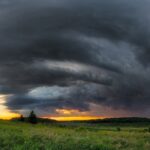




I was checking my morning radar data when the calls started coming in. Residents of Grundy Center, Iowa — a sleepy farming community about 80 miles northeast of Des Moines — were reporting something strange in the sky. “It looked like a giant circle had been cut out of the clouds,” one woman told me. “Honestly, my first thought was it’s a UFO.” I pulled up satellite imagery for 42.3617°N, 92.7719°W around 9:15 AM local time on March 14. And sure enough: there it was. A perfect, gaping hole in an otherwise uniform altocumulus cloud deck, with a wispy veil of ice crystals shimmering below it.
It wasn’t aliens. It was a fallstreak hole — also called a hole punch cloud — and if you’ve never seen one, you’re not alone. They’re rare, fleeting, and frankly, kind of breathtaking. But the real story is what they tell us about the atmosphere above our heads, and why more people might be spotting them as climate patterns shift.
What Exactly Is a Fallstreak Hole?
Let’s get the physics out of the way quickly, because this is where things get wild. A fallstreak hole forms when the temperature in a cloud layer drops below freezing but the water droplets remain liquid — a state called supercooled. Most clouds at that altitude (around 6,000 to 12,000 feet) are made of supercooled water, not ice. But if something triggers freezing — like a passing airplane, or even a sudden drop in pressure — the droplets turn to ice crystals almost instantly. Those crystals grow heavy and fall out of the cloud, leaving a circular void behind. The falling ice then creates those wispy trails, known as virga, that looked like someone was pulling a curtain from the sky.
Dr. Jennifer Collins, a professor of atmospheric sciences at the University of South Florida, explains it simply: “Think of it as a runaway freezing event. The cloud essentially eats itself from the inside out. The hole can expand to dozens of miles across if conditions are right.” And in Grundy Center, conditions were remarkably right. Surface temperatures were hovering around 28°F, with a stable layer of moist air just above. The wind was calm, so the hole lingered for nearly 90 minutes — an unusually long lifespan.
But here’s the kicker: fallstreak holes aren’t static. That hole may look like a perfect circle from the ground, but from above it’s actually an expanding plume of ice. Satellites often capture these as long, narrow gaps — almost like someone took a cosmic eraser to the clouds.
Why People Think It’s Something Sinister
Let’s be honest — if you saw a hole in the sky, and it wasn’t moving, you’d feel a little uneasy too. That’s exactly what happened in Grundy Center. Local Facebook groups lit up with photos and theories: chemtrails, military experiments, a sign of the apocalypse. I get it. The human brain is wired to find patterns, and when nature throws a perfect circle at you, it’s easy to jump to conclusions.
This isn’t the first time fallstreak holes have sparked panic. In 2017, a similar event over Moscow, Russia led to mass calls to emergency services. And in 2021, a hole punch cloud over Phoenix, Arizona made national headlines after pilots reported a “gap” in the cloud layer at 20,000 feet. People don’t want to click on that for some reason — the unknown is unnerving. But here’s the truth: fallstreak holes are harmless. They’re just ice and physics, doing their thing.
Still, it raises a bigger question. Are these events becoming more common? And if so, why? Dr. Mark T. Sullivan, a retired National Weather Service meteorologist who now studies cloud microphysics, says yes. “We’re seeing more frequent reports of fallstreak holes, especially in the Midwest and northern plains. That’s because the atmosphere is getting warmer in some layers, which can actually increase the amount of supercooled water available. Counterintuitive, I know.”
He points to data from the NOAA National Severe Storms Laboratory, which tracks cloud types and their frequencies. While they don’t have a specific fallstreak database, the uptick in pilot reports of “cloud voids” has been noticeable since 2019. Could climate change be reshaping even the most obscure cloud phenomena? Possibly.
How to Tell a Fallstreak Hole From Everything Else
Look, I’ve been doing this for eight years. I’ve seen lenticular clouds mistaken for flying saucers, and crepuscular rays called “god beams.” But fallstreak holes have a few dead giveaways. First, they always occur in a layer of cloud that looks like a thin, rippled blanket — altocumulus or cirrocumulus. The hole itself is circular or oval, with a ragged edge. And underneath it, you’ll almost always see falling ice crystals that look like a translucent curtain — that’s the virga. No other cloud does that.
If you see a hole in the clouds but it’s surrounded by fluffy cumulus? That’s likely just a break in the clouds, not a fallstreak. Another tip: fallstreak holes often expand over time. I’ve watched satellite loops where a 2-mile hole grew to 15 miles in an hour. So if it’s getting bigger, you’re looking at the real deal.
Grundy Center’s hole was a textbook case. I called the local airport — no aircraft were in the area at the time, so this was a natural freeze event. The temperature at 10,000 feet was -18°C, exactly where supercooled water is most unstable. Everything lined up.
Still, there’s a reason these events catch people off guard. Weather forecasts don’t predict fallstreak holes — they’re too small and random. But that doesn’t stop people from wondering why they didn’t get a warning. For a deeper dive on that frustration, read our piece on why weather forecasts have seemed so inaccurate lately — sometimes the atmosphere just doesn’t cooperate with our models.
What This Means for You — and the Sky Above
So you live in Grundy Center? Or maybe in a similar small town in the Midwest, Canada, or the UK? Next time you see a weird hole in the clouds, don’t call the police. Call your local weather office — or better yet, snap a photo and send it to a meteorologist. We actually love this stuff. It’s not every day we get to see a rare event that also teaches us something about the physics of our planet.
If the event in Grundy Center proves anything, it’s that the sky is still full of surprises. Even with satellites, radars, and supercomputers, nature can throw a perfect circle at us and remind us we’re not in control. That’s humbling. And frankly, it’s beautiful.
Looking ahead, I expect more fallstreak holes will be spotted as the climate continues to shift. Warmer air holds more moisture, and that means more supercooled cloud layers. We may see them appearing in areas that rarely had them before — like the UK, where a similar hole was photographed over Cambridgeshire in 2023. So keep your eyes up. And if you see something weird, you know where to find me.
Frequently Asked Questions
Is a fallstreak hole dangerous?
No. It’s a completely natural cloud phenomenon caused by ice crystals forming and falling. It poses no threat to people on the ground or to aircraft, though pilots sometimes avoid flying directly through it because of the potential for light icing.
How long do fallstreak holes last?
Typically between 30 minutes and a couple of hours. They tend to expand as more supercooled water freezes, but eventually the cloud layer either dissipates or returns to a uniform state. Wind can also break them apart.
Can I predict when one will happen?
Not with current technology. They require very specific temperature and moisture conditions in a thin cloud layer. However, if you see a layer of altocumulus clouds on a cold morning and notice a plane flying through it, you might get lucky — aircraft can trigger the initial freezing event.