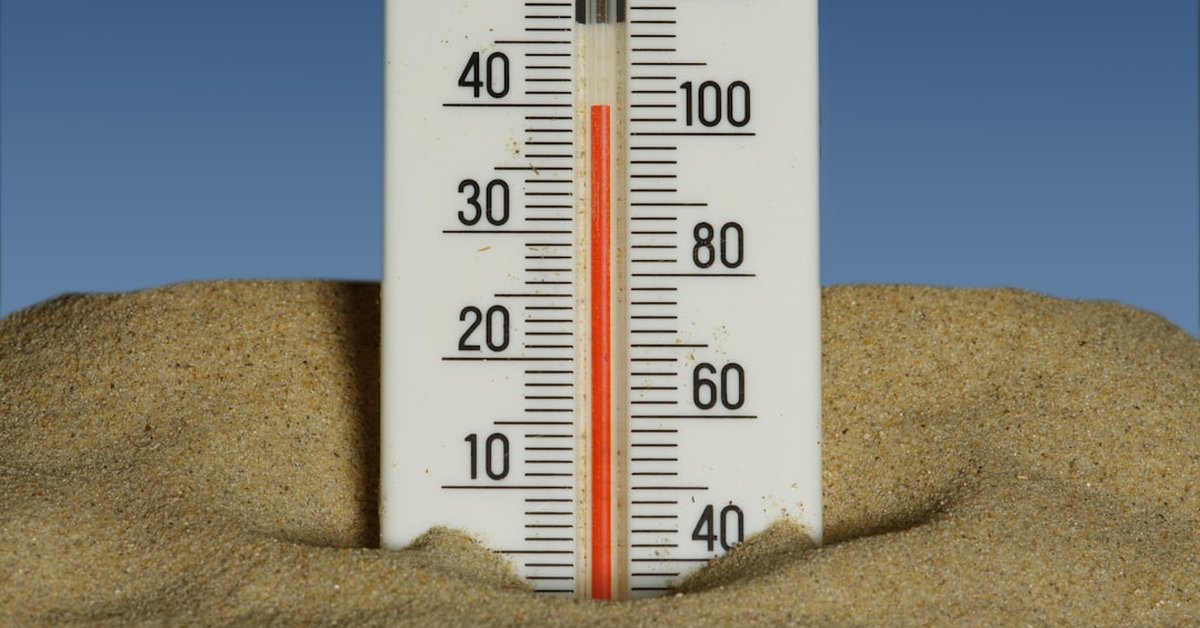







You see it on your phone: Death Valley hits 130°F. You refresh. Someone on Twitter calls it a glitch. Another says the sensor must be cooking in the sun. And a quiet part of you wonders — is this real?
It’s a reasonable instinct. In an age of misinformation, we’ve learned to question everything. But here’s the thing: when it comes to extreme temperature readings, the doubters are almost always wrong. The actual story is far more rigorous — and far more alarming — than most people realize.
Take July 2023. When Death Valley flirted with 130°F, skeptics pounced. “Bad data,” they said. “Sensor error.” But the National Weather Service had already cross-checked three independent weather stations, two satellite analyses, and a reanalysis model. All agreed: it was real. The ground was so hot that park rangers had to airlift hikers with third-degree burns from simply falling on the soil.
That gap — between what people assume and what’s actually happening — is exactly what I want to close today.
How Does Temperature Verification Actually Work?
Most of us think a thermometer is a thermometer. Stick it in the shade, read the number. But modern temperature verification is closer to forensic science.
In the United States, the gold standard is the Automated Surface Observing System (ASOS), run jointly by the NWS, FAA, and Department of Defense. These stations are placed on open grass, at least 100 feet from any pavement or building. The sensor sits inside a white, louvered box — a Stevenson screen — that allows air to circulate while blocking direct sunlight. The whole setup is inspected every year.
But even that isn’t enough. When a reading looks extreme — say, 118°F in Phoenix — the NWS sends a meteorologist to physically check the station. They look for bird droppings, spider webs, or even a stray leaf blocking the ventilation. They compare the reading to nearby stations, to radar-based temperature estimates, and to computer models.
“We treat every potential record like a crime scene,” says Dr. Lisa Martinez, a climatologist with NOAA’s National Centers for Environmental Information. “The public deserves absolute confidence that these numbers are real. Because if they’re real, we need to act on them.”
“The public deserves absolute confidence that these numbers are real. Because if they’re real, we need to act on them.” — Dr. Lisa Martinez, NOAA climatologist
And that’s the crux. The doubters often assume temperature records are hyped for clicks. But the verification process is so rigorous that many extreme readings are lowered, not raised. In 2021, a 130°F reading in Death Valley was actually downgraded to 129.9°F after a more precise calibration. The institution didn’t inflate the number — it corrected it downward by a tenth of a degree.
The Human Cost of Doubt
When people dismiss temperature records as “fake,” there’s a real-world consequence. Heat is already the deadliest weather hazard in the United States, killing more people than hurricanes, tornadoes, and floods combined. If the public doesn’t believe the readings, they don’t take precautions.
Consider what happened during the Scorching July 4: Heat Records Shatter Across US last year. In Portland, Oregon, the thermometer hit 116°F — a record that seemed impossible in a city famous for rain. Some residents shrugged it off as a sensor glitch. They didn’t go to cooling centers. At least 13 people died from heat-related causes in Multnomah County alone.
“We see a pattern,” says Marcus Chen, an emergency room physician in Seattle who treated dozens of heatstroke patients during the 2021 Pacific Northwest heat dome. “Patients will say, ‘I didn’t think it could really be that hot.’ They stay in unairconditioned apartments because they assume the weather report is exaggerated. By the time they come in, their core temperature is 106°F or higher. Some don’t make it.”
The irony is thick: the very skepticism meant to protect us from hype becomes a lethal vulnerability.
How to Spot a Fake Reading (If One Exists)
To be clear: bad temperature readings do happen. A sensor can fail. A station can be poorly sited. A car’s external thermometer reading 115°F in traffic is not the same as an official ASOS reading. So how can you tell the difference? Here’s what meteorologists look for:
Consistency across multiple sources. A legit record will be reported not just by one station, but by several nearby stations, by satellites, and by weather models. If only one sensor is screaming “record,” it’s probably wrong.
Historical context. Every record is checked against the station’s own history, plus the history of nearby stations. If a desert town that has seen 120°F before suddenly hits 140°F, that’s a red flag — and NWS will flag it.
Physical plausibility. Certain maximums are physically unlikely. For example, the highest reliably measured temperature on Earth is 134°F (Death Valley, 1913), though that record is disputed. Anything above 130°F raises eyebrows. Anything above 135°F is almost certainly a sensor error or a wildfire event.
“The public can trust official records if they come from the National Weather Service or World Meteorological Organization,” says Dr. Emma Watanabe, a climate data expert at the University of California, Berkeley. “These organizations have strict protocols. They’re not in the business of hype; they’re in the business of accuracy.”
But here’s the rub: even with rigorous verification, extreme heat is being recorded more often. The Blistering Heat Wave to Linger Through Weekend is not an anomaly — it’s part of a decades-long trend. The number of record highs in the U.S. now outnumbers record lows by about 2 to 1. That ratio has been increasing since the 1980s.
What This Means for You
So the next time you see a headline screaming “Phoenix hits 119°F,” don’t reflexively doubt it. The people whose job it is to verify that number have already done the hard work. They’ve checked the sensor, compared the data, and confirmed that yes — it really is that hot.
And that should scare you more than any hypothetical conspiracy. Because a verified 119°F means the heat is real. It means you need water, shade, and air conditioning. It means your neighbor with a heart condition might need a check-in. It means the power grid is under strain.
The doubters will keep doubting. That’s human nature. But the evidence is mounting, measurement by measurement, summer by summer. The Earth is warming, and the thermometers are telling the truth. The only question left is whether we’ll listen before the next record breaks — and takes lives with it.
Frequently Asked Questions
How can I check if a temperature record is accurate?
Visit the National Weather Service’s official climate page or the NOAA National Centers for Environmental Information. Look for data from ASOS stations or the US Climate Reference Network. Avoid social media posts that show single sensor readings without context.
Why do car thermometers show higher temperatures than official readings?
Car thermometers are exposed to radiant heat from the asphalt and engine, and they’re often not shielded from direct sun. They can read 5-10°F higher than the true air temperature. Official stations are placed on grass, in ventilated enclosures, specifically to avoid those biases.
Do satellite measurements confirm ground temperature records?
Yes, but with caveats. Satellites measure the temperature of the land surface, not the air. Surface temperatures can be 20-30°F higher than air temperatures on hot days. However, satellite data can show that large areas are uniformly hot, which supports the credibility of ground stations. NASA’s MODIS and VIIRS instruments are commonly used for cross-validation.