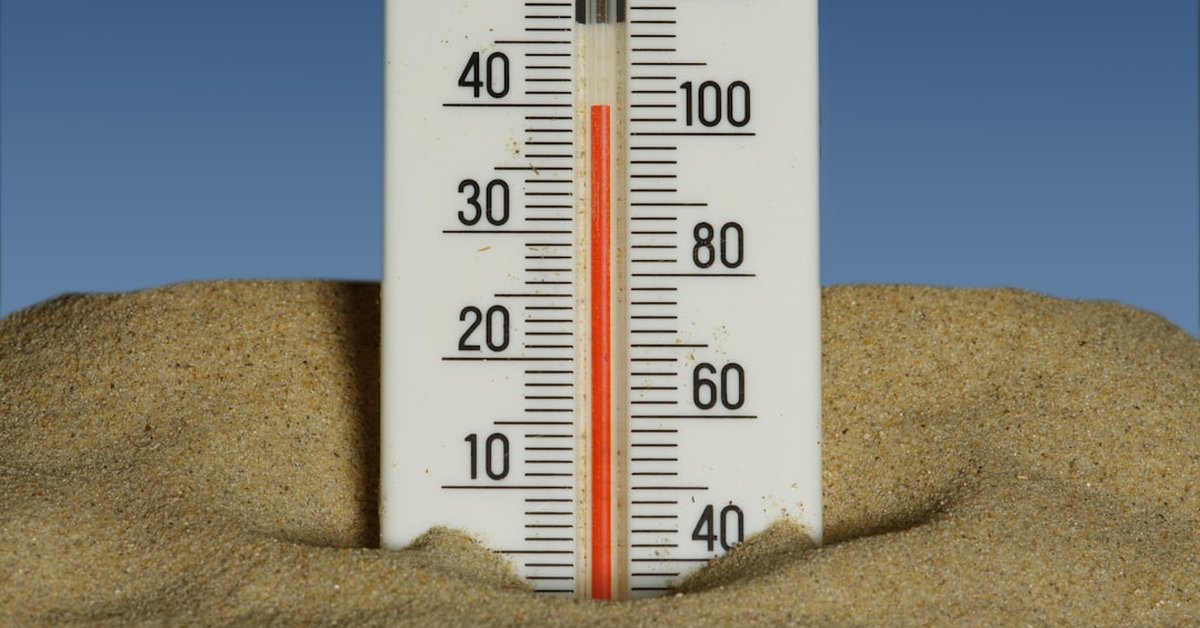








I stepped out of my apartment near Queen and Spadina yesterday afternoon and felt it immediately — that thick, wet blanket of air that makes you wonder if someone forgot to close the door to a steam room. By 3 PM, Toronto had hit 36°C. But the real story wasn’t the temperature. It was the dew point: 25°C.
For anyone who’s ever tried to explain humidity to a visitor, dew point is the number that matters. When it hits 20°C, it’s uncomfortable. At 25°C, it’s oppressive — the kind of air that makes your lungs work harder and your shirt stick to your back before you’ve walked a block. Yesterday, Toronto crossed into territory more typical of New Orleans or Mumbai in July.
Environment Canada’s weather station at Pearson International Airport recorded the 36°C high around 2:45 PM, with the dew point hovering near 25°C for several hours. The humidex — a metric that combines heat and humidity — peaked at 45. That’s not just hot. That’s in the “extreme caution” zone where heat stroke becomes a real risk after prolonged exposure.
And here’s the thing: this wasn’t an isolated event. It’s part of a pattern we’ve been tracking all summer.
The Numbers Behind the Discomfort
A dew point of 25°C means the air is holding nearly 24 grams of water vapor per cubic meter. For context, a typical summer day in Toronto sees dew points between 15°C and 18°C. Yesterday’s reading was almost 40% higher. The National Oceanic and Atmospheric Administration’s heat index chart shows that when the air temperature is 36°C and the dew point is 25°C, the “feels like” temperature jumps to roughly 45°C — right at the threshold where the CDC warns that heat exhaustion and heat stroke can occur quickly during physical activity.
Toronto has seen dew points this high before — notably during the July 2018 heat wave that saw 35°C with a dew point of 24°C — but it’s still rare. Environment Canada data going back to 1955 shows that dew points above 24°C occur in Toronto only about once every two or three years. Yesterday’s reading tied the all-time record for the city in June, last set in 2012.
But here’s what keeps climatologists up at night: the frequency is increasing. First Europe, Then North America: Welcome to Heat Dome Summer — the pattern that baked London and Paris in June has now settled over the Great Lakes, and it’s not just about the temperature. The moisture is coming from somewhere.
A Growing Pattern: Heat Domes and Dew Points
Dr. Elena Vasquez, a climatologist at the University of Toronto’s School of the Environment, explained the mechanics: “When a heat dome settles over a region, it traps not just heat but also moisture. The Great Lakes are still warm — surface temperatures are running 2 to 3 degrees above normal — so evaporation feeds the humidity. The result is a double whammy: high heat plus high dew point that pushes the humidex into dangerous territory.”
She’s right. Lake Ontario’s surface temperature this week is around 22°C, about 2.5°C above the 30-year average for late June. That extra warmth pumps more water vapor into the air, which then gets trapped under the heat dome. The same mechanism drove last week’s Heat Wave Spreads East on Wednesday as 160 Million Brace for Record Fourth of July — an event that’s now pushing heat indices above 43°C from Chicago to Washington, D.C.
Yesterday in Toronto wasn’t a record for raw temperature — the all-time high is 40.6°C set in July 1936 — but it was a record for what scientists call “wet-bulb temperature,” a measure that combines heat and humidity to estimate the point at which the human body can no longer cool itself by sweating. Wet-bulb temperatures above 35°C are considered unsurvivable for more than a few hours. Yesterday, Toronto’s wet-bulb temperature hit 29°C. That’s not fatal, but it’s high enough to stress anyone working outdoors, playing sports, or unable to access air conditioning.
“We’re seeing conditions that used to be rare become more common,” said Dr. Vasquez. “If you look at the trend lines for both temperature and dew point in the Great Lakes region since 1980, both are rising. The combination is accelerating faster than either metric alone.”
What This Means for Your Health
At a dew point of 25°C, sweat doesn’t evaporate efficiently. Your body’s primary cooling mechanism — evaporative cooling — breaks down. That means your heart has to work harder to pump blood to your skin, your core temperature rises, and within minutes you can start feeling dizzy, nauseous, or confused.
Dr. Michael Chen, an emergency physician at St. Michael’s Hospital in Toronto, saw the effects firsthand yesterday. “We had eight patients come in with heat-related illness between noon and 6 PM,” he said. “That’s about triple what we’d see on a normal hot day. Two were elderly patients who don’t have AC. One was a construction worker who collapsed on site. The humidity was the factor — it prevents your body from cooling itself.”
The CDC’s extreme heat guide recommends limiting outdoor activity when the heat index exceeds 40°C, drinking water even if you don’t feel thirsty, and checking on neighbors who are elderly or have chronic conditions. Yesterday, Toronto’s heat index hit 45°C. The city opened seven cooling centers, and the Red Cross reported distributing 1,500 bottles of water at transit stations.
But here’s the reality: many Toronto apartments, especially older buildings, lack air conditioning. A 2021 report from the Canadian Institute for Climate Choices found that only 45% of Toronto homes have central AC. Window units are common, but during a heat wave, they struggle to keep up when the dew point is 25°C and the temperature is 36°C. The air they pump inside is still humid — and humidity makes heat feel worse even indoors.
Looking Ahead: A Hotter Baseline
The weather pattern that produced yesterday’s steam bath isn’t going away soon. The heat dome is forecast to linger over southern Ontario through at least Thursday, with humidex values expected to stay above 40 each afternoon. And beyond this week, the larger trend is sobering.
A study published last year in Geophysical Research Letters projected that by 2050, the number of days per year in Toronto with a dew point above 24°C could quadruple — from roughly one day every two years to four days per year. That’s not a heat wave anymore. That’s a new summer normal.
“We’re moving into a climate where the term ‘extreme heat’ loses meaning because it becomes baseline,” Dr. Vasquez said. “Our infrastructure — power grids, public transit, housing — wasn’t built for this. We’re going to have to adapt fast.”
Yesterday was a warning shot. A 36°C day with a 25°C dew point is still rare in Toronto. But if the trends hold, it won’t be for long. And the difference between rare and routine? That’s measured in lives, hospital visits, and the quiet suffering of people trapped in hot apartments with no relief.
I walked home from the subway last night, and the air still felt heavy at 10 PM. The humidex was still above 32. I thought about the people who don’t have the option to wait it out. And I wondered how many more days like this we’re going to see before we take the threat seriously.
Frequently Asked Questions
Why is dew point a better measure of discomfort than humidity?
Relative humidity changes with temperature — a 100% humidity reading at 5°C feels totally different than 100% at 35°C. Dew point is an absolute measure of moisture in the air. When the dew point is above 20°C, most people start to feel uncomfortable. Above 24°C, it’s oppressive and dangerous for prolonged outdoor activity. It’s the metric meteorologists use to assess heat stress risk.
How does Toronto’s heat compare to other cities that had a 36°C day with a 25°C dew point?
Cities in the U.S. Gulf Coast — like Houston, New Orleans, and Tampa — see dew points of 25°C or higher regularly during summer. For them, a 36°C day with that humidity is dangerous but not extraordinary. For Toronto, it’s a rare event. The difference is that those southern cities are built for it — with widespread air conditioning, shaded architecture, and public awareness campaigns. Toronto is not. That’s what makes it a public health concern.
What should I do if I’m caught outside when the heat index hits 45°C?
First, get out of direct sun and find shade or air conditioning immediately. Drink water — not alcohol or caffeine. Remove any heavy clothing. If you feel dizzy, nauseous, or develop a headache, those are early signs of heat exhaustion. Wet a cloth with cool water and place it on your neck, armpits, and groin to help cool your blood. If symptoms worsen or you stop sweating, call 911 — that could be heat stroke, which is a medical emergency.