






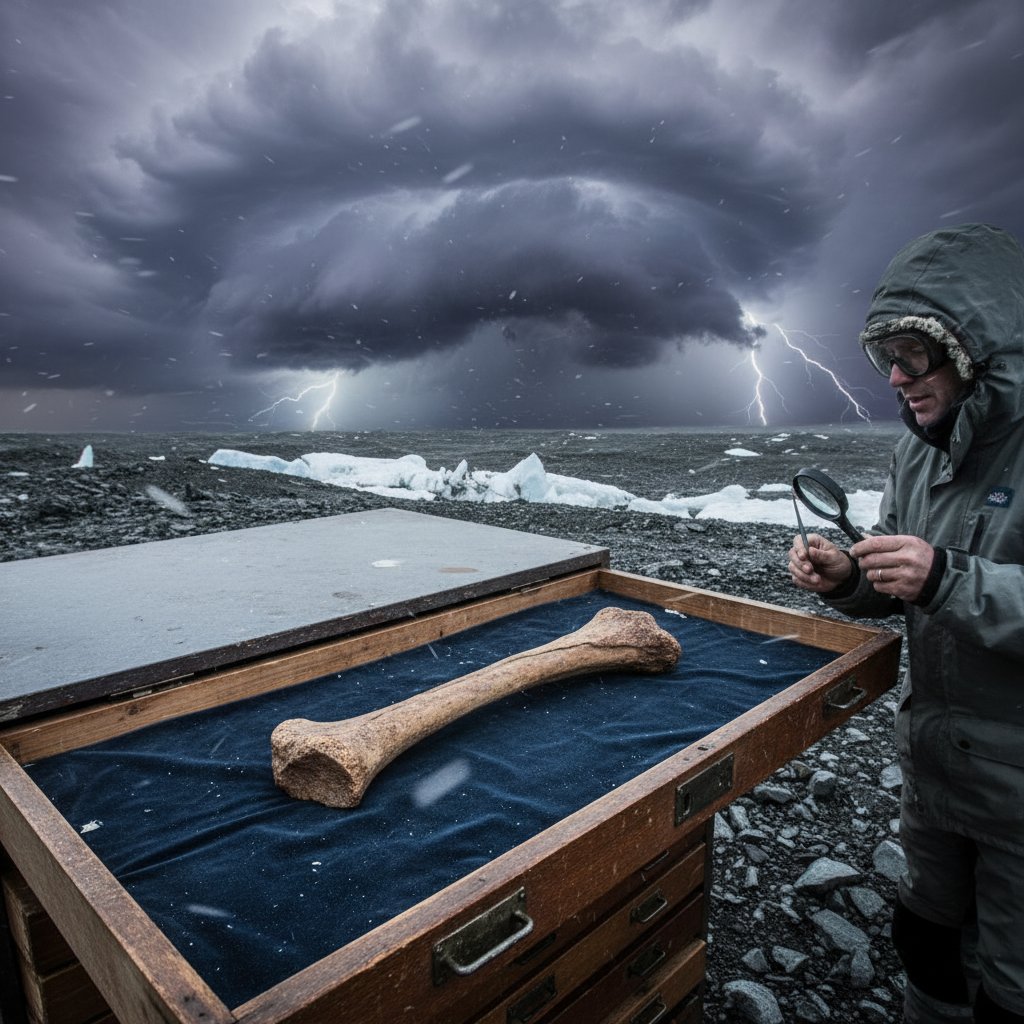
Look, I’ve filed stories from hurricane-battered coastlines and wildfire-scorched hillsides, but nothing quite prepared me for the news that broke this week from a quiet museum drawer in South America. It’s the kind of discovery that makes you re-evaluate everything you thought you knew about the frozen continent. Buried in a collection at the National Museum of Brazil, researchers have identified the first dinosaur bone ever recovered from Antarctic soil – a piece of tail from a massive Titanosaur, casually collected in 1985 and then forgotten.
The fossil, a single vertebra, sat untouched for nearly four decades. It’s a reminder that sometimes the most profound scientific breakthroughs aren’t found in remote ice fields or deep drill cores. They’re hiding underneath a layer of dust in a filing cabinet. And for those of us who track extreme weather and geological shifts, this discovery rewrites the story of how a continent of ice once hosted creatures that could shake the earth.
The Bone That Went Missing
The story begins in the austral summer of 1985–86, when a team of paleontologists from Brazil slogged across the Antarctic Peninsula. They were hunting for fossils in the rocky outcrops of Seymour Island – a place that, even for Antarctica, feels like the edge of the world. The team brought back a collection of Cretaceous-era rocks and fossil fragments. Among them was a single, unassuming bone about the size of a human fist. They packed it up, shipped it to Rio de Janeiro, and then… nothing.
The vertebra sat in the museum’s collection, mislabeled and ignored. It wasn’t until 2021, during a systematic review of forgotten specimens, that a sharp-eyed graduate student noticed something odd. The bone’s structure didn’t match any known marine reptile or bird – the usual suspects for Antarctic Cretaceous fossils. It had the classic hallmarks of a sauropod dinosaur: hollow chambers, a bulbous centrum, and a shape that screamed “long-necked giant.”
“It was sitting there all along, in plain sight,” said Dr. Juliana Machado, a paleontologist at the Museum of Earth Sciences in Rio and lead researcher on the study, published in Scientific Reports. “We just weren’t looking for it. It’s a humbling reminder of how much is still waiting to be found in museum collections.”
A Titanosaur in the Ice
So what exactly did they find? The vertebra came from the tail of a titanosaur – a group of sauropods that includes some of the largest land animals to ever live. Think Argentinosaurus, think Dreadnoughtus. These were creatures that stretched 30 meters from nose to tail, weighed as much as a small airplane, and roamed the southern continents during the Late Cretaceous, roughly 70 million years ago.
But here’s the kicker: Antarctica at that time wasn’t the frozen wasteland we know today. It was a temperate forest, draped in ferns and conifers, with cool summers and chilly winters – think modern-day New Zealand or Patagonia. The titanosaur likely thrived in that environment, munching on cycads and dodging the occasional predatory theropod. The vertebra proves that sauropod dinosaurs ranged farther south than any previous fossil evidence suggested.
“This is a game changer,” said Dr. Kenneth Lacovara, a paleontologist at Rowan University and discoverer of Dreadnoughtus, who wasn’t involved in the study. “It shows that giant dinosaurs were able to live at high latitudes, in environments with prolonged periods of darkness and cold. That challenges a lot of assumptions about dinosaur physiology and migration.”
And it’s not just about dinosaurs. The find has implications for understanding how life responds to climate change – a topic that feels eerily relevant as we watch a winter storm warning paralyze the Northeast with three feet of snow. I mean, if a 40-ton reptile could survive months of Antarctic winter darkness, maybe there are lessons here about resilience in the face of extreme weather.
What This Means for the Future of Antarctic Science
Let’s be real – Antarctica is a nightmare for fieldwork. The weather is brutal, logistics are a nightmare, and funding is always tight. But discoveries like this one are sparking renewed interest in the continent’s fossil record. Researchers are already planning new expeditions to Seymour Island and other outcrops, hoping to find more dinosaur remains – maybe even a complete skeleton.
“We’ve barely scratched the surface,” said Dr. Machado. “There are likely hundreds, maybe thousands of fossils sitting in museum drawers around the world, waiting to be rediscovered. The Antarctic Peninsula holds incredible secrets, and we’re just starting to uncover them.”
That’s the weird thing about science – and about writing about it. One minute you’re covering a government website going dark and the next you’re talking about a dinosaur that roamed a forest where only penguins now live. It all connects. The National Weather Service outage yesterday wasn’t just an IT glitch – it was a reminder of how fragile our modern systems are. But this fossil discovery? It’s a reminder that nature has been dealing with far bigger disruptions for far longer than we have.
The titanosaur vertebra is now re-cataloged and on display at the National Museum of Brazil, which famously suffered a devastating fire in 2018 that destroyed most of its collection. This bone survived that blaze. It survived decades of neglect. And now it’s telling a story that scientists are only beginning to decode.
Frequently Asked Questions
Was this the first dinosaur ever found in Antarctica?
No – other dinosaur fossils have been found in Antarctica, including a species of ankylosaur and a theropod. But this is the first dinosaur bone ever collected from Antarctica that was later identified as such. Earlier finds were mostly bone fragments or teeth. This vertebra is a single, complete element from a known group – the titanosaurs – making it a landmark discovery for paleontology.
How did a dinosaur survive in Antarctica if it was cold?
During the Late Cretaceous, Antarctica was not covered in ice. The climate was temperate, similar to modern-day Chile or New Zealand. Winters were long and dark, but temperatures rarely dropped below freezing. Titanosaurs were likely warm-blooded or had metabolic adaptations that allowed them to endure seasonal cold. The find also raises new questions about whether some dinosaurs migrated to avoid the dark months.
Could there be more dinosaurs hiding in museum collections?
Absolutely. This discovery was made not in the field, but in a drawer. Many museums hold unidentified or mislabeled fossils that were collected decades ago. The rise of CT scanning and better comparative databases means that paleontologists are increasingly finding treasures in stored collections. As Dr. Machado put it, “These are the unsung heroes of paleontology – the neglected specimens that hold the answers.”