



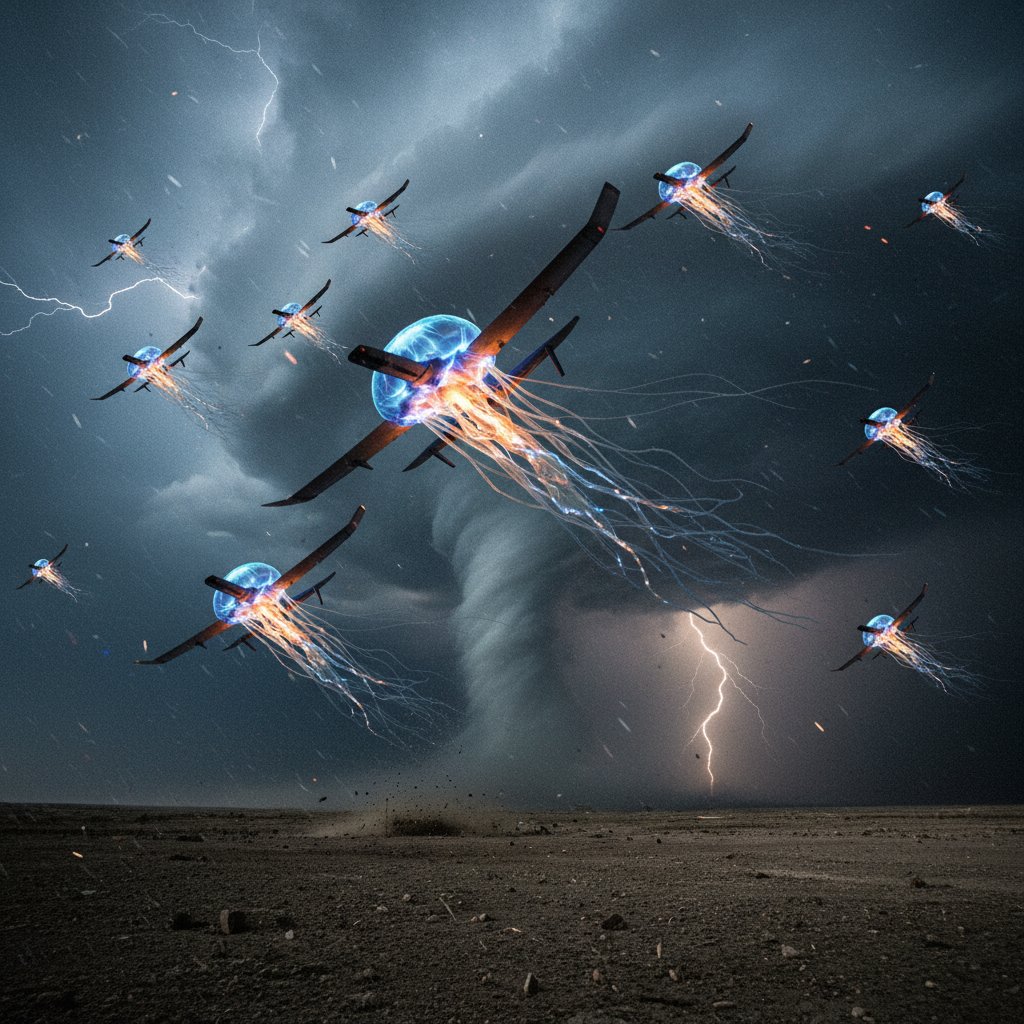
Forget the storm surge. Forget the aftershock. The next big threat to disaster response isn’t another hurricane or earthquake – it’s a swarm of cheap, Iranian-made drones that look like jellyfish. And they’re already being used to test our defenses.
In recent months, reports have emerged of Iran deploying a new class of unmanned aerial vehicle (UAV) nicknamed the “Jellyfish” – a small, low-cost quadcopter that can be produced in vast numbers and used for surveillance or precision attacks. While military analysts have focused on their role in conflicts across the Middle East, there’s a quieter, more insidious risk: these drones could be unleashed during natural disasters, when emergency services are stretched thin and the public is most vulnerable. That’s not just a war story – it’s a civilian protection crisis.
What Exactly Is a Jellyfish Drone?
Iran’s Jellyfish drone – sometimes referred to as the “Medusa” in open-source intelligence circles – is a small, battery-powered quadcopter with a flight time of about 30 minutes and a range of roughly 10 kilometers. It carries a small explosive payload or can be used for reconnaissance. But the key feature is cost: each unit can be produced for a few hundred dollars. That makes them expendable, swarming weapons – think locusts, but with cameras and explosives.
But why the name? Because like a jellyfish, they’re almost invisible in the water – or in this case, the sky. Their small size and quiet motors make them hard to detect on radar, especially in cluttered environments like a city after a disaster. And when they swarm, they can overwhelm defenses. Sound familiar? It’s the same principle that made the Reuters report on Iran’s Jellyfish drone so alarming: this is a weapon designed for saturation attacks.
Look, drones aren’t new. But the Jellyfish represents a democratization of precision attack capability. Any actor with a few thousand dollars can now field a swarm that can hit multiple targets simultaneously. For disaster zones, that’s a nightmare scenario.
Why Disaster Zones Are the Perfect Target
When a major earthquake hits, the first 72 hours are critical. Power grids are down. Communication networks are spotty. First responders are scrambling to reach the injured. That’s exactly when an adversary might strike – not with tanks or jets, but with a cloud of cheap drones targeting emergency vehicles, field hospitals, or even weather monitoring stations.
Consider the Vanuatu earthquake from earlier this year. After a 5.3 magnitude tremor, relief teams faced logistical chaos. Now imagine a swarm of Jellyfish drones homing in on their only supply route. Or the Samoa Islands earthquake – a 5.1 jolt along the Ring of Fire that left residents vulnerable. A drone attack during that window would be devastating, and almost impossible to counter while the ground is still shaking.
“Disasters create a perfect opportunity for asymmetric threats,” says Dr. Sarah Chen, a security analyst at the Center for Strategic Studies. “Emergency responders are not equipped for drone swarms. Their protocols are built for natural hazards, not deliberate attacks. That’s a gap Iran’s Jellyfish drones could exploit.” And she’s right – most disaster response frameworks don’t include counter-UAV measures. No one’s thinking about jammers or nets when they’re pulling survivors from rubble.
Historical Parallels: From IEDs to Drones
This isn’t the first time non-state actors have used disasters as cover. After the 2005 Pakistan earthquake, insurgents attacked relief convoys. After the 2010 Haiti earthquake, there were reports of looters targeting aid supplies. But drones change the game. They’re faster, more precise, and harder to trace.
“We’ve seen a shift from improvised explosive devices to improvised aerial threats,” says Prof. Mark Thompson, a disaster response specialist at the University of Exeter. “The Jellyfish drone is essentially an IED that flies. It can be launched from a rooftop miles away, strike a specific vehicle, and then the operator melts into the crowd. For disaster managers, that’s a whole new level of complexity.”
And unlike a hurricane or an earthquake, drone attacks can be repeated, targeted, and timed for maximum chaos. The weather community has long warned that climate change will increase the frequency of extreme events. Now we have to worry about man-made threats piggybacking on those events. It’s a double whammy.
The Broader Implications for Weather Monitoring
CyclonePost readers know that accurate weather data saves lives. But what if someone deliberately takes out a Doppler radar station during a hurricane landfall? Or spoofs GPS signals to misdirect relief flights? The Jellyfish drone – or its successors – could do that. Iran’s drone program has already shown the ability to carry electronic warfare payloads. A small drone hovering over a weather buoy could disable it, or replace its data with false readings.
This isn’t science fiction. In 2023, a swarm of unidentified drones disrupted operations at a major US airbase. If they can do that to hardened military targets, imagine what they can do to a temporary field hospital or a mobile weather station after a 5.1 earthquake in Halmahera.
“The Jellyfish drone is a wake-up call,” says Dr. Chen. “We need to integrate drone defense into disaster preparedness. That means training first responders, stockpiling jammers, and creating no-fly zones over critical infrastructure during emergencies.” Because the alternative – watching a swarm of cheap drones turn a disaster into a massacre – is unthinkable.
So what happens next? Iran continues to refine the Jellyfish, and other nations are taking notes. The technology is spreading. For disaster planners, it’s time to add “drone swarm” to the list of hazards alongside floods, fires, and earthquakes. Because the next big storm might not just bring wind and water – it might bring a swarm.
Frequently Asked Questions
What exactly is Iran’s Jellyfish drone?
The Jellyfish drone is a small, low-cost quadcopter developed by Iran. It is designed for swarming attacks, carrying small explosive payloads or surveillance equipment. Its name comes from its ability to blend into the environment and overwhelm defenses, similar to a jellyfish swarm in the ocean.
How could Jellyfish drones threaten disaster response?
During natural disasters like earthquakes or hurricanes, emergency services are often concentrated in vulnerable, temporary locations. A swarm of Jellyfish drones could attack these sites, disrupting relief efforts, targeting first responders, or damaging critical infrastructure such as weather stations and communication towers. The chaos of the disaster provides cover for the attack.
Are there any countermeasures available for disaster zones?
Yes, but they are not yet standard. Options include electronic jammers that disrupt drone control signals, net-based capture systems, and directed energy weapons. However, most disaster response agencies lack training and equipment for counter-drone operations. Experts recommend integrating drone detection and mitigation into future disaster preparedness plans.