





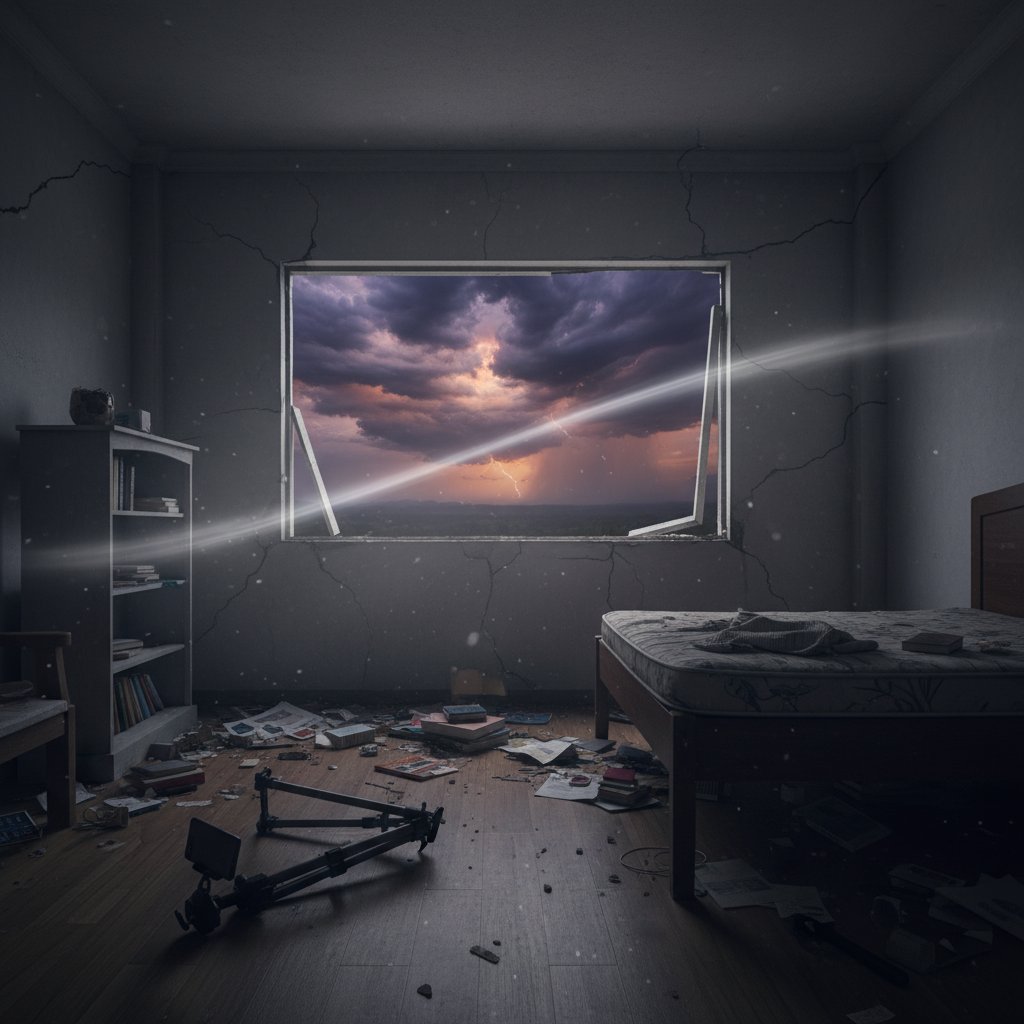
The floor buckles. The walls groan. A bookshelf topples, sending a cascade of books across the room. This is the terrifying reality captured in a new video from the June 8th magnitude 7.8 earthquake that struck the island of Mindanao in the southern Philippines. The footage, filmed by a friend of this reporter who is thankfully safe, offers a visceral, ground-level view of a major seismic event—a perspective that statistics and seismographs can never convey.
That moment, when the solid ground becomes a heaving, unreliable surface, is the signature of a shallow-focus earthquake. The June 8th quake, which struck at 5:47 PM local time, originated at a depth of approximately 32 kilometers (20 miles) off the coast of Sarangani Province. It was the strongest tremor to hit the region since a devastating 7.5-magnitude quake in 2023.
A Room, a Phone, and the Unpredictable Earth
The video is brief but harrowing. The camera, likely a smartphone set down on a desk, shows a modest bedroom. At first, there is a subtle sway—the kind that might be mistaken for dizziness. Then, the motion escalates. The frame shakes violently. A ceiling fan rattles. The bookshelf, a heavy wooden unit, sways and finally crashes forward, spilling its contents. The audio picks up a low, rumbling groan, followed by the sound of breaking glass and a woman’s scream from another room.
My friend, who wishes to remain anonymous for privacy, was at home in General Santos City, about 100 kilometers from the epicenter. He was on his bed when the shaking began. “I thought it was just a mild tremor, but then it kept getting stronger,” he said in a brief message. “I couldn’t stand. I just held onto the bed frame and waited. It felt like minutes, but I know it was less than thirty seconds.” He emerged with only a few scrapes from falling debris. His room, however, is a testament to the chaos that unfolded.
This footage is more than a personal memento. It is a critical data point for researchers studying how structures behave during real-world seismic events. Dr. Maria Reyes, a structural engineer at the Philippine Institute of Volcanology and Seismology (PHIVOLCS), notes the value of such amateur recordings. “We use these videos to calibrate our models of building response,” she explains. “They show us the actual frequency of the shaking, the direction of wave propagation, and the failure points of common household objects. This is raw, unfiltered data that helps us understand what actually happens inside a room during a high-intensity earthquake.”
“This is raw, unfiltered data that helps us understand what actually happens inside a room during a high-intensity earthquake.” — Dr. Maria Reyes, structural engineer, PHIVOLCS
The Broader Context: Why This Quake Matters
The Mindanao earthquake was not an isolated event. It is part of a complex tectonic dance in the Philippine Mobile Belt, a region where the Philippine Sea Plate is subducting beneath the Sunda Plate along the Philippine Trench. This fault zone is one of the most seismically active on Earth, producing thousands of tremors each year. The June 8th event was notable for its size and its location near populated areas.
The US Geological Survey (USGS) reported that the quake triggered a local tsunami warning, which was later lifted. Aftershocks, including several of magnitude 5.0 or greater, have continued to rattle the region. In the city of General Santos, schools were closed, power lines were downed, and at least three buildings sustained significant structural damage. The Philippine National Police reported two fatalities, both from heart attacks triggered by the panic, and over 50 injuries, mostly from falling objects.
For context, a magnitude 7.8 earthquake releases approximately 22 times more energy than a magnitude 7.0. It is comparable to the 2023 Turkey-Syria earthquake sequence, though the Mindanao event occurred at a slightly greater depth, which likely reduced surface-level damage. Still, the potential for destruction is immense.
What the Video Tells Us About Preparedness
Watching my friend’s video, one detail stands out: his room lacked any secured furniture. The bookshelf that toppled was not anchored to the wall. This is a common oversight in earthquake-prone regions, even in countries like the Philippines where seismic awareness is high. “The biggest danger during an earthquake is often not the building collapsing, but furniture tipping over, light fixtures falling, and glass shattering,” says Dr. James Chen, a disaster preparedness specialist at the University of California, Berkeley. “This video is a stark reminder that we prepare our bodies for the shaking, but we often forget to prepare our environment.”
Dr. Chen advises that viewers take this footage as a call to action. Secure bookshelves, cabinets, and water heaters with straps or brackets. Identify safe spots in every room—under a sturdy table or against an interior wall. Practice the “Drop, Cover, and Hold On” procedure. “If you watch that video and you don’t feel a need to check your own furniture anchors, you’re missing the point,” he adds.
“This video is a stark reminder that we prepare our bodies for the shaking, but we often forget to prepare our environment.” — Dr. James Chen, disaster preparedness specialist, UC Berkeley
Looking Ahead: The Next Big One?
The June 8th earthquake will inevitably raise questions about whether this is a precursor to an even larger event. Seismologists are cautious. The Philippine Trench is capable of generating a magnitude 9.0 megathrust earthquake, similar to the 2011 Tohoku quake in Japan. However, the 7.8 event does not necessarily signal an imminent catastrophe. “Large earthquakes often occur in clusters, but predicting the next one remains impossible,” Dr. Reyes explains. “What we can do is improve our building codes, our early warning systems, and our public education. The Mindanao quake was a test of our systems. We need to learn from it.”
For now, my friend is safe, though shaken. His room is being repaired. The bookshelf has been donated to a secondhand shop. In its place, he plans to install a wall-mounted shelf, secured with metal brackets. “Every time I see that video, I feel the fear again,” he says. “But I also feel lucky. I want to make sure my luck isn’t tested again.” His video serves as a powerful, personal document of nature’s power—and a sobering reminder that for millions living along fault lines, the ground is never quite as solid as it seems.