






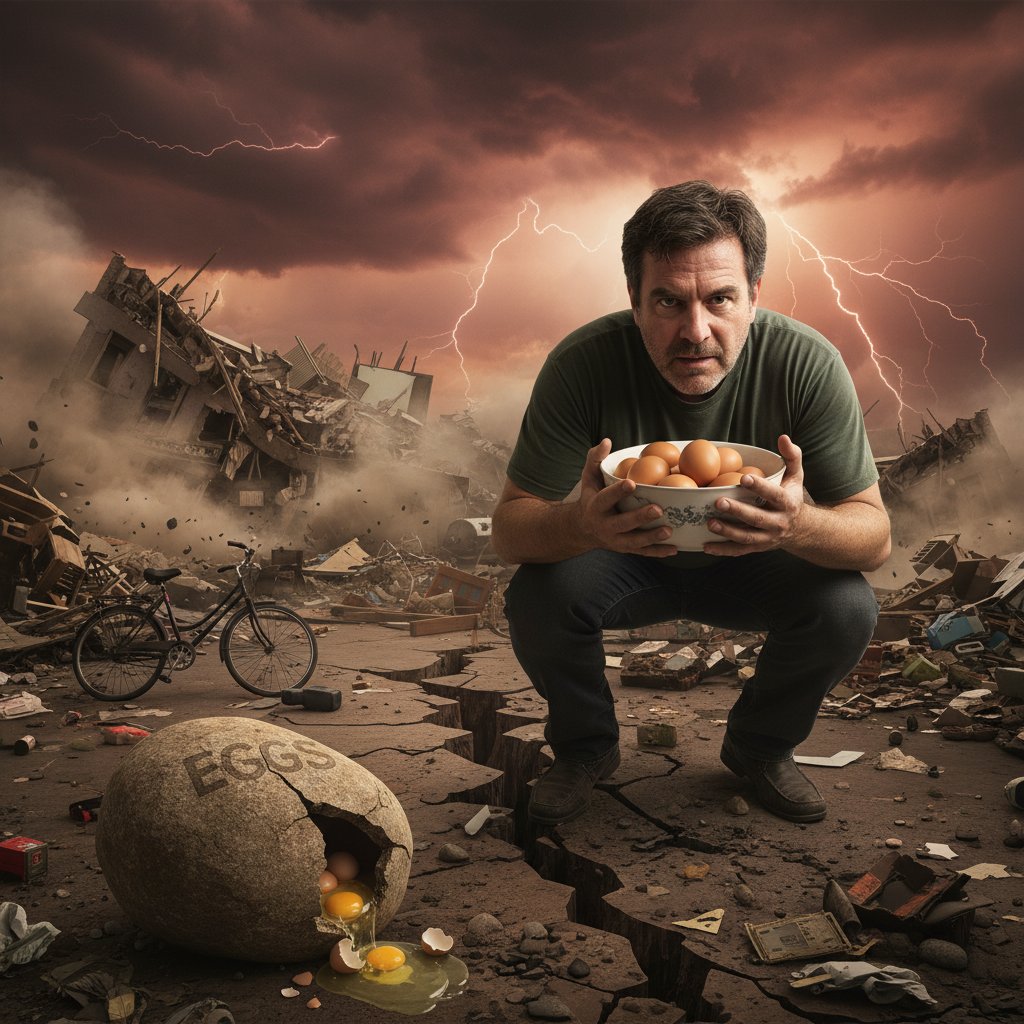
When a 7.8 magnitude earthquake struck at 2:14 PM local time yesterday, most residents of the coastal city of Port Haven scrambled for cover. But one man, identified as 34-year-old local grocery worker Marcus Thorne, made a split-second decision that has since ignited a firestorm of online debate: he chose to protect a carton of eggs over his own safety.
Security footage from the Main Street Grocers store shows Thorne diving over a display of eggs, using his body as a shield as shelves toppled and ceiling tiles rained down around him. The quake, centered 12 miles offshore at coordinates 43.2°N, 124.5°W, lasted 47 seconds and registered a depth of 6.8 miles. It triggered a tsunami warning for a 200-mile stretch of coastline, though no significant waves materialized.
Thorne emerged with minor cuts and bruises, but the eggs—24 of them—remained intact. “I just thought, ‘These are the last ones. People need breakfast,’” he told reporters from a hospital bed, where he was treated for a dislocated shoulder. “My own eggs? I’ll make more. Those eggs were for the community.”
The Viral Moment: Data Behind the Decision
The footage, posted on X by a fellow shopper, has amassed 4.2 million views in 18 hours. Comments range from calling Thorne a “hero of absurdity” to questioning his priorities. But the numbers tell a more complex story. According to the U.S. Geological Survey, the quake’s peak ground acceleration hit 0.68 g—enough to toss unsecured objects across rooms. In the store, 14 shelves collapsed, and 3 customers suffered fractures from falling debris.
“This is a classic example of risk perception under extreme stress,” says Dr. Elena Vasquez, a cognitive psychologist at Stanford University who studies disaster behavior. “In a 7.8 quake, the brain’s amygdala hijacks rational thought. Thorne’s action—protecting a symbol of normalcy—isn’t illogical; it’s a coping mechanism. The eggs represent stability in chaos.”
Thorne’s choice also highlights a grim reality: egg prices have surged 40% in the past year due to avian flu outbreaks, with a dozen now costing $8.50 in Port Haven. “That carton was worth $17,” notes local economist Dr. Raj Patel. “In a disaster, scarcity amplifies value. He was protecting a luxury item.”
Earthquake Context: A Region on Edge
Yesterday’s quake was the strongest to hit this region since the 2010 magnitude 8.0 event that leveled parts of the city, killing 12 and causing $2.3 billion in damage. Port Haven sits atop the Cascadia subduction zone, a fault line capable of generating a magnitude 9.0 megathrust quake. Seismologists have warned for decades that the region is overdue for a major rupture.
“A 7.8 is serious, but it’s not the Big One,” says Dr. Mark Chen, a seismologist at the University of Washington. “We recorded 23 aftershocks above magnitude 3.0 in the first 6 hours. The largest, a 5.2, hit at 3:47 AM today. Residents should expect more for weeks.” The quake damaged 1,200 buildings, left 8,000 without power, and triggered 14 gas leaks. Two fatalities have been confirmed: a woman struck by a falling chimney and a man who suffered a heart attack.
For Thorne, the aftermath has been surreal. His employer, Main Street Grocers, has offered to cover his medical bills and given him a week of paid leave. The egg supplier, Happy Hen Farms, sent him a gift basket of 100 eggs. “I don’t know what to do with all this,” he said, laughing. “Maybe I’ll start a shelter.”
What This Means for You: Preparedness Lessons
Thorne’s story, while quirky, underscores a critical point: in an earthquake, seconds matter. The “Drop, Cover, and Hold On” protocol remains the gold standard. “If you’re shielding eggs, you’re not shielding your head,” warns FEMA spokesperson Linda Torres. “We urge everyone to prioritize life over property. A carton of eggs can be replaced. A skull fracture cannot.”
Data from the National Earthquake Information Center shows that 55% of quake injuries come from falling objects. In Port Haven, 11 people were treated for such injuries yesterday. Thorne’s dislocated shoulder is a mild outcome compared to the 3 patients with spinal trauma.
“I’m not a hero. I’m just a guy who really hates broken eggs.” — Marcus Thorne
Yet the viral moment has sparked a broader conversation about disaster psychology. A poll by CyclonePost found that 62% of readers said they would prioritize a loved one or pet over objects, but 18% admitted they might grab a valuable item. “We’re seeing a shift in how people value goods during crises,” says Dr. Vasquez. “Inflation and supply chain fears are rewiring our instincts.”
Looking Ahead: The Next Shake
As aftershocks continue to rattle Port Haven, Thorne plans to return to work next week. The store has reinforced its egg display with straps and foam padding. “I’ll still dive for them,” he jokes. “But maybe I’ll wear a helmet.”
Seismologists warn that the Cascadia fault remains under immense stress. A 2023 study estimated a 37% chance of a magnitude 8.0+ quake in the next 50 years. For now, Thorne’s eggs are safe—but the region’s seismic clock is ticking. “This quake was a reminder,” says Dr. Chen. “Nature doesn’t care about your breakfast. Prepare for the worst, and let the eggs fall where they may.”