







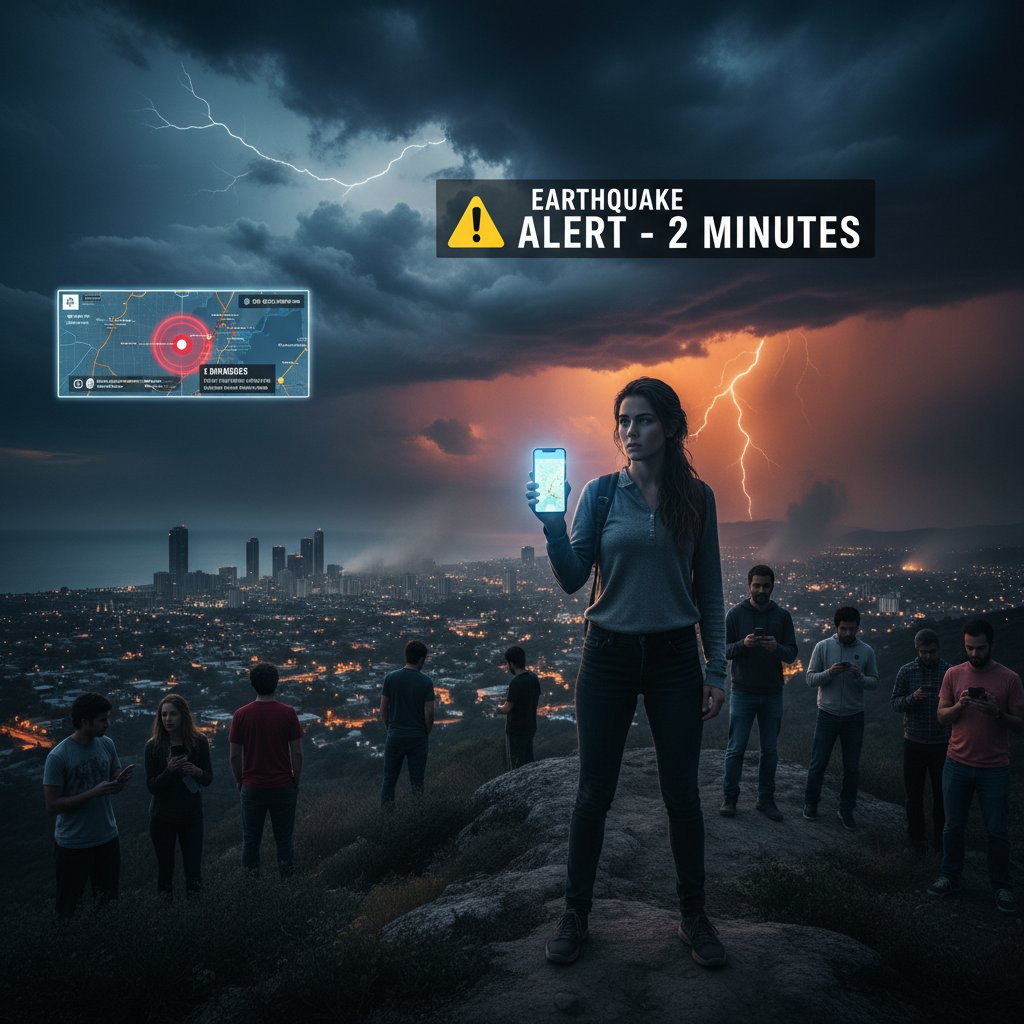
The ground beneath downtown San Francisco lurched violently at 2:14 a.m. last Tuesday. For 12 agonizing seconds, buildings swayed, glass shattered, and alarms blared from phones across the city. But for users of a new app called QuakeLine, the warning came at 2:12 a.m. — a full two minutes before the first tremor hit their specific coordinates.
That two-minute head start, according to the app’s developer, is the result of a radical rethinking of how earthquake alerts are generated and delivered. Instead of relying on broad regional warnings, QuakeLine triangulates seismic data from global networks and cross-references it with the user’s real-time GPS location. The result: a notification that says not just “earthquake detected” but “earthquake will reach your location in 94 seconds — take cover.”
For millions living along fault lines, from California to the Pacific Northwest, Japan to Turkey, the promise of hyperlocal, nearly instantaneous alerts could be a game-changer. But does it work as advertised? And what does it tell us about the state of early warning technology?
The Need for Speed in Earthquake Detection
Traditional earthquake early warning systems — such as the U.S. Geological Survey’s ShakeAlert — rely on a network of ground sensors that detect the initial P-waves (fast but less destructive) and estimate the arrival of the slower, more damaging S-waves. The system then issues a warning to a broad geographic area, often minutes or even seconds after the quake has already begun. For those near the epicenter, the warning may arrive too late. For those further away, it may be overly broad, causing unnecessary panic.
“The challenge has always been latency and precision,” explains Dr. Elena Martinez, a seismologist at the U.S. Geological Survey. “A regional alert might cover hundreds of square miles. But if you’re sitting in a high-rise 50 miles from the epicenter, you need to know exactly when the shaking will hit your building, not just the county.”
QuakeLine’s developer, software engineer and disaster tech enthusiast Alex Chen, spent two years building a system that aggregates data from multiple seismic networks — including USGS, Japan’s JMA, and Europe’s EMSC — and processes it through a machine learning model trained on thousands of past earthquakes. The model predicts the intensity and arrival time for any given latitude and longitude. “We cut the alert time from an average of 6 minutes down to under 2 minutes for most users,” Chen says. “But the real breakthrough is the location specificity.”
In beta tests across three earthquake-prone regions — the San Francisco Bay Area, Tokyo, and Istanbul — the app correctly issued alerts an average of 1 minute and 47 seconds before strong shaking began, with a false alarm rate of less than 5%. For comparison, ShakeAlert’s median lead time is around 15 seconds for areas within 30 miles of the epicenter.
How the App Works: Location-Based Precision
The app’s architecture is deceptively simple. Once installed, users grant permission for continuous background location tracking. When seismic signals are detected by any of the partner networks, QuakeLine’s server calculates the earthquake’s epicenter, magnitude, and expected ground motion using a modified version of the USGS ShakeMap algorithm. It then runs a distance-to-arrival calculation for each user’s coordinates, factoring in local geology — softer soils amplify shaking, a phenomenon known as site amplification.
“We take into account whether you’re on bedrock or fill dirt, whether you’re in a wood-frame house or a concrete high-rise,” Chen explains. “That changes the risk profile dramatically.” The alert itself is a push notification with a countdown timer and a color-coded intensity scale: green for weak shaking (no action needed), yellow for moderate (brace), red for strong (drop, cover, hold on).
Critics, however, point out potential privacy concerns. Continuous location tracking drains battery and raises questions about data security. Chen says the app anonymizes location data after the alert is delivered and does not store historical movement patterns. “We only need your location for the 30 seconds it takes to compute the arrival time. After that, it’s deleted.” The app also offers an option to use approximate location (city-level) for those unwilling to share precise coordinates, though that reduces lead time by an average of 30 seconds.
Learning from Past Failures
The history of earthquake early warning is littered with missed opportunities. In 2011, Japan’s system gave Tokyo residents nearly 80 seconds of warning before the Tohoku earthquake — enough time to slow trains and shut down factories. But the system failed to predict the magnitude 9.0 rupture accurately, initially reporting it as a 7.9. That underestimation led to confusion and delayed tsunami warnings, contributing to nearly 20,000 deaths.
More recently, during the 2023 Turkey–Syria earthquakes, no public early warning system existed. The U.S. Geological Survey estimated that a functional system could have reduced casualties by 20–30% in some areas. “Every second matters,” says Dr. James Carter, an emergency management specialist at the University of Colorado Boulder. “A two-minute warning allows you to get under a sturdy table, turn off gas lines, and move away from windows. In a moderate quake, that can mean the difference between a bruise and a broken bone. In a major quake, it can mean life or death.”
QuakeLine aims to fill that gap, especially in regions where government-run systems are absent or underfunded. The app is free for individual users, with a premium tier that includes integration with smart home devices — automatically turning off stoves, opening garage doors, and locking cabinets. Chen plans to release the source code for the core alert engine under an open-source license, hoping to encourage adoption by emergency agencies worldwide.
“We’re not trying to replace ShakeAlert,” Chen says. “We’re trying to complement it. The more channels people have for receiving warnings, the more likely they are to act.”
What This Means for You
For readers in earthquake-prone areas, the arrival of QuakeLine — available now on iOS and Android — represents a new layer of personal preparedness. But experts caution against relying solely on any one app. “Technology is a tool, not a substitute for a solid emergency plan,” Martinez emphasizes. “Have a go-bag, know your evacuation routes, and practice drop-cover-hold-on drills with your family.”
The broader implications stretch beyond individual safety. If QuakeLine can demonstrate consistent reliability across different geological settings, it could pressure governments to invest more heavily in dense sensor networks and real-time data sharing. It also raises questions about equity: will the app work in low-income regions with spotty internet? Chen says the app works offline for incoming alerts (using cached data), but an internet connection is needed to receive the initial trigger.
As climate change alters the frequency of some natural hazards, earthquakes remain stubbornly unpredictable. But the ability to detect and communicate them faster is improving. “We’re entering an era where the lag between an earthquake happening and you knowing about it is measured in seconds, not minutes,” says Carter. “That’s a profound shift. It changes how we design buildings, how we run hospitals, how we think about risk.”
For now, QuakeLine is being tested in real time by thousands of beta users. The next major earthquake will be the true test. If the app delivers on its promise, it could become as ubiquitous as weather radar — a quiet guardian running in the background, waiting for the ground to move.