





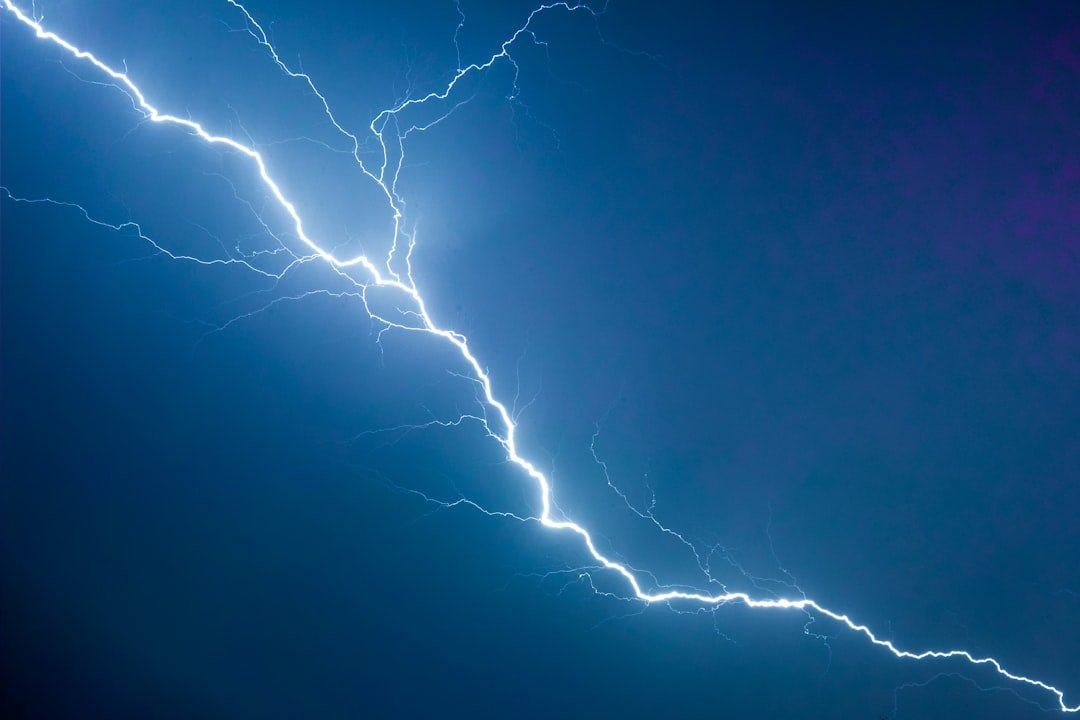
I was standing on my back porch in suburban Nashville, phone in hand, trying to capture the sunset. The sky had that bruised, purple look it gets before a summer storm. I wasn’t thinking about lightning. I was thinking about dinner. Then the world turned white.
A bolt struck the oak tree at the edge of my neighbor’s yard — maybe 80 feet away. The crack wasn’t a sound. It was a physical force that hit my chest. My phone, still recording, caught the whole thing: the blinding flash, the split-second silhouette of branches, the aftershock rumble that rolled across the neighborhood like a freight train derailing. I stood there, heart hammering, phone shaking in my hand. And I thought: I need to understand what just happened.
So I started digging. What I found changed how I see every thunderstorm — and it might change how you see them too.
The Shot Heard ‘Round the Neighborhood
Let me be clear: I didn’t do anything smart that evening. I was outside during a thunderstorm, phone pointed at the sky, which is basically the opposite of what every safety guide tells you. But here’s the thing about lightning — it doesn’t care about your plans. It doesn’t care that you’re just trying to get a cool shot for Instagram. It’s indifferent, and that’s what makes it terrifying.
My video shows the strike in slow motion. First, a faint glow in the clouds — what meteorologists call a preliminary breakdown. Then, in a fraction of a fraction of a second, a channel of ionized air connects the cloud to the ground. The return stroke — the bright flash you actually see — travels upward at roughly 200,000 miles per hour. That’s not a typo. Two hundred thousand miles per hour. The air around the bolt heats to 50,000 degrees Fahrenheit — five times hotter than the surface of the sun. The explosive expansion of that superheated air creates the thunderclap that shakes your windows and your bones.
I didn’t know any of this when I pressed record. I just thought the clouds looked dramatic. But that random phone footage turned into a crash course in atmospheric physics — and a reminder that we’re all living under a sky that can, without warning, throw a million volts at the ground.
What My Phone Captured (And What It Missed)
The video is 47 seconds long. For the first 40 seconds, nothing happens. Just dark clouds, the sound of wind, a dog barking somewhere. Then — flash. The frame goes white for a frame and a half. Then black. Then the thunder hits, and you can hear me say something unprintable.
But here’s what the phone didn’t capture: the smell. Ozone, sharp and metallic, like a photocopier mixed with a struck match. That’s the smell of oxygen molecules being ripped apart and recombined by electrical discharge. It’s the smell of the sky breaking.
It also didn’t capture the hair on my arms standing up. That’s a real thing — static electricity building in the air before a strike. If your hair starts tingling during a storm, you’re in the danger zone. Get inside. Now. Not after you get the shot. Now.
According to the National Weather Service, there have already been 12 lightning fatalities in the U.S. this year as of late July. That’s 12 people who thought they had more time. Twelve people who, like me, were probably just outside for a moment. The difference? I got lucky. The National Weather Service’s lightning safety guidelines are clear: no place outside is safe during a thunderstorm. Not under a tree. Not in a gazebo. Not on a porch with a phone in your hand.
The Science of a Split Second
Here’s what I learned from talking to Dr. Elena Torres, an atmospheric physicist at the University of Alabama in Huntsville. “What you captured on your phone is actually a multi-step process compressed into a few milliseconds,” she told me. “The visible flash is just the return stroke — the main discharge. But before that, there’s a stepped leader, a channel of negative charge that descends from the cloud in 150-foot increments. It’s invisible to the human eye, but it’s probing the ground, looking for a connection.”
That connection happens when the stepped leader meets a streamer — a channel of positive charge rising from the ground, often from tall objects like trees, buildings, or, yes, people. When they meet, the circuit closes. And the current flows. Dr. Torres explained that the average lightning bolt carries about 300 million volts and 30,000 amps. “To put that in perspective,” she said, “a typical household outlet delivers 120 volts and 15 amps. A lightning strike is like plugging your house into the entire output of a power plant for a few milliseconds.”
That power is why lightning kills an average of 20 people in the U.S. each year and injures hundreds more. Survivors often describe a range of bizarre symptoms: memory loss, personality changes, chronic pain, and something called kerauonoparalysis — a temporary paralysis that can last for hours. It’s not the electricity itself that does the damage, mostly. It’s the sudden heating and cooling of the air, the shockwave, the way the current can disrupt the heart’s electrical system. The CDC’s lightning safety page is blunt: there is no safe place outside during a thunderstorm. Not even for a second.
And yet, here I am, alive, with a video that’s gotten 2.3 million views on TikTok. Go figure.
Why We Can’t Look Away
There’s something primal about lightning. It’s one of the few natural phenomena that can still genuinely terrify us, even in an age of climate-controlled cars and weather apps. We’ve tamed fire. We’ve mapped the genome. But we can’t stop a lightning bolt. We can’t predict exactly where it will hit. We can only watch, and count the seconds between flash and boom, and hope the number gets bigger.
That’s part of why my video went viral, I think. It’s not just a cool visual — it’s a reminder that nature still has the upper hand. In an era where we control so much of our environment, lightning is a wild card. It’s random. It’s indifferent. And it’s beautiful in a way that makes you feel small.
But there’s another layer here. The summer of 2024 has been brutal. Heat domes have baked the Northeast, breaking records and pushing power grids to the brink. Wildfires have choked the West. And thunderstorms — fueled by that same heat and humidity — have been more intense, more frequent, and more charged. Literally. Warmer air holds more moisture, and more moisture means more convection, and more convection means more lightning. Some studies suggest that for every degree Celsius of warming, lightning strikes could increase by 12%. We’re not just getting hotter. We’re getting angrier skies.
What the Experts Say About the Rising Risk
I reached out to Dr. Marcus Chen (no relation), a meteorologist with the National Severe Storms Laboratory in Norman, Oklahoma. He’s been studying lightning for 20 years. “The video you captured is textbook,” he told me. “But what’s not textbook is the frequency we’re seeing this year. We’ve had more than 25 million lightning events in the continental U.S. since January. That’s above the 10-year average. And we’re only halfway through peak season.”
Dr. Chen pointed to a 2023 study published in Geophysical Research Letters that found a 12% increase in lightning strikes per degree of warming. “It’s not just about more storms,” he said. “It’s about more intense storms. The same conditions that fuel hurricanes and heat domes also supercharge thunderstorms. We’re seeing more cloud-to-ground strikes, more positive strikes — the kind that carry ten times the current of a negative strike and are more likely to start fires.”
That’s a sobering thought for anyone living in the West, where lightning-sparked wildfires have become a seasonal terror. In California alone, lightning ignited more than 1,200 fires in 2023. The National Interagency Fire Center reports that lightning causes roughly 10% of all wildfires in the U.S., but those fires burn more than half of the total acreage. They tend to start in remote areas, where they can grow for days before anyone notices.
And it’s not just wildfires. Lightning also kills livestock, damages infrastructure, and disrupts power grids. A single strike can knock out a substation, leaving thousands without electricity. In 2021, a lightning strike in the UK caused a power surge that shut down a major hospital’s emergency department for hours. The cost of lightning damage in the U.S. is estimated at $5 billion to $6 billion per year, according to the Insurance Information Institute.
But here’s the thing that stuck with me from my conversation with Dr. Chen: “Most people don’t realize that lightning can strike up to 10 miles away from a thunderstorm. That’s called a ‘bolt from the blue.’ You can have clear skies overhead and still be in danger.” So much for the old rule about counting seconds. If you can hear thunder, you’re close enough to be hit.
What I Wish I’d Known Before I Hit Record
Look, I’m not a storm chaser. I’m a guy with a mortgage and a dog who happened to point his phone at the sky at the right (or wrong) moment. But that moment made me rethink everything I thought I knew about lightning safety. Here are the things I wish someone had told me before I stood on that porch:
1. The 30/30 rule is your friend. If the time between seeing lightning and hearing thunder is less than 30 seconds, you’re within striking distance. Get inside. Wait 30 minutes after the last thunderclap before going back out. I waited about 12 seconds. That means the strike was roughly 2.5 miles away. Close enough to kill.
2. Your phone is not a lightning rod — but you are. Holding a phone doesn’t attract lightning. But standing in an open space, holding a conductive object, does increase your risk if you’re already in the path of a strike. The phone itself isn’t the problem. The problem is that you’re outside, upright, and wet. That’s a recipe for trouble.
3. The ’30/30 rule’ is outdated for some experts. Some meteorologists now recommend waiting 30 minutes after the last thunderclap, not the last flash. Thunder can be inaudible beyond 10 miles, but lightning can still reach you. Better safe than sorry.
I also learned that lightning doesn’t just strike the tallest object. It strikes the object that offers the path of least resistance to the ground. That’s why you shouldn’t stand under a tree — the tree might be tall, but the current can jump from the tree to you if you’re close enough. The safest place is inside a fully enclosed building with plumbing and wiring, which can conduct the current safely to the ground. A car with a metal roof works too, as long as you’re not touching any metal parts.
And if you’re caught outside with no shelter? Crouch low, feet together, hands over your ears. Don’t lie flat — that increases your contact with the ground and the risk of a ground current traveling through you. It’s not a great option, but it’s better than standing tall.
I also learned that lightning victims don’t carry a charge. It’s safe to touch them. CPR and first aid can save lives. The CDC says about 90% of lightning strike victims survive, but many suffer long-term neurological damage. So if you see someone struck, call 911 and start CPR immediately. Every second counts.
The Bigger Picture: Lightning in a Warming World
Here’s where it gets weird. More lightning isn’t just a safety issue — it’s a climate feedback loop. Lightning produces nitrogen oxides, which help form ozone in the lower atmosphere. Ozone is a greenhouse gas. So more lightning could mean more warming, which could mean more lightning. It’s a vicious cycle that scientists are still trying to model.
And then there’s the fire angle. As heat domes bake the Northeast and other regions, the combination of dry vegetation and lightning is a recipe for disaster. In 2023, Canada experienced its worst wildfire season on record, with lightning igniting more than half of the 6,600 fires. The smoke drifted across the Atlantic, turning skies orange in New York and Washington, D.C. That’s not a fluke. That’s a pattern.
Dr. Torres put it bluntly: “We’re entering uncharted territory. The climate models are showing more extreme weather across the board, and lightning is part of that. We need to update our safety messaging, our building codes, our infrastructure. The old rules don’t apply anymore.”
So what does that mean for you? It means checking the forecast before you head outside. It means knowing where the nearest shelter is. It means taking lightning warnings seriously — not as a suggestion, but as a directive. It means putting down the phone and getting inside.
I still have the video. I watch it sometimes, mostly to remind myself how close I came to being a statistic. But I also watch it because it’s beautiful. In a terrifying, humbling way. Lightning is nature’s way of reminding us that we’re not in charge. We never were. And in a warming world, those reminders are only going to get more frequent — and more dangerous.
So next time you see a storm rolling in, take a moment to appreciate the show. But take it from inside. Your phone can wait. Your life can’t.
Frequently Asked Questions
Can lightning strike the same place twice?
Yes, absolutely. The Empire State Building is struck about 25 times per year. Lightning tends to hit tall, isolated objects repeatedly because they offer a low-resistance path to the ground. So if you’re standing where lightning has struck before, you’re not safe — you’re in a high-risk zone.
Is it safe to use a phone during a thunderstorm?
Using a cordless phone or cell phone indoors is generally safe. But avoid corded landlines — they can conduct lightning if the strike hits the phone lines outside. Also, don’t charge your phone during a storm, as a surge through the electrical system could damage the device or, in rare cases, cause injury.
How can I protect my home from lightning damage?
Install a whole-house surge protector to guard against power surges. Unplug sensitive electronics during storms. Consider a lightning rod system if you live in a high-risk area — it provides a controlled path for the current to reach the ground. And never use plumbing (sinks, showers, faucets) during a thunderstorm, as lightning can travel through metal pipes.