


We’re losing our ability to look up.
It’s a harsh truth, but one I see playing out in every town square and suburban street. Our gaze is so often fixed downward—on screens, on pavement, on the relentless demands of the immediate—that we often miss the profound, breathtaking dramas unfolding just above us. And when those dramas combine elements of rare atmospheric beauty with the raw, unscripted grace of the natural world, well, it’s a moment that demands our attention, a forceful reminder to lift our eyes.
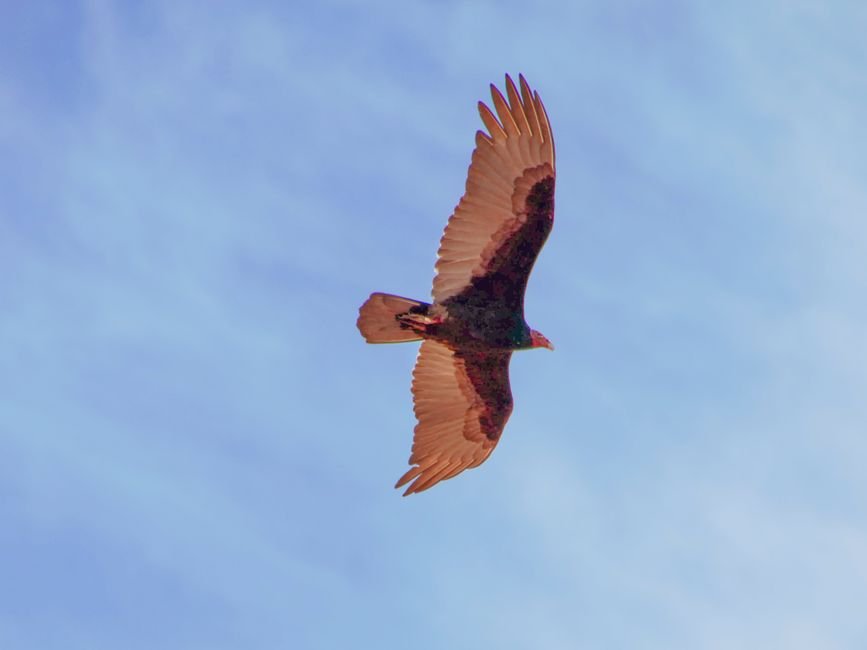
That’s precisely what happened late Tuesday evening, June 18th, over the skies of Southeast Michigan. As the sun dipped low, casting long shadows across the landscape, a spectacle of ethereal light painted the heavens. It wasn’t just a sunset; it was a Circumzenithal arc—an ‘upside-down rainbow’—blazing with impossible colors directly overhead. And then, as if on cue, a solitary Turkey Vulture, wings spread wide, glided effortlessly through the very heart of that celestial phenomenon. It was a fleeting tableau, a perfect convergence of physics and biology, a moment of wild, quiet magic that, for anyone fortunate enough to witness it, must have felt like a secret whispered by the sky itself.
The Arc: An Upside-Down Symphony of Light
The Circumzenithal arc, or CZA, is one of the most vibrant and often overlooked members of the atmospheric optical family. Unlike the familiar rainbow, which forms opposite the sun, a CZA appears directly above you, often when the sun is relatively low in the sky—typically less than 32 degrees above the horizon. It’s a phenomenon born from the precise interaction of sunlight with hexagonal ice crystals suspended in high-altitude cirrus clouds. Think of these ice crystals as tiny, perfectly cut prisms, each one catching the sun’s rays and bending them at just the right angle to create a brilliant, intensely colored arc.
Here’s the thing: while rainbows are common, CZAs are less so, primarily because the conditions must be just right. The ice crystals need to be flat and oriented horizontally, like tiny falling dinner plates, and the sun’s angle has to fall within a very specific range for the light to enter one face of the crystal and exit another, refracting into its constituent colors. When these conditions align, you get an arc that can be far more vivid than a typical rainbow, with distinct, pure colors—violet on the inside, red on the outside—curving away from the sun’s position. It looks like a smile painted across the zenith, hence the ‘upside-down rainbow’ moniker.
“To see a Circumzenithal arc with such clarity and intensity is always a gift,” explains Dr. Elena Petrova, an Atmospheric Optics Specialist at the University of Michigan. “It requires very specific meteorological conditions—high cirrus clouds, perfectly formed and oriented ice crystals, and a sun angle that’s just right. It’s a testament to the complex and beautiful physics constantly at play in our atmosphere. When you add a living creature like a bird into that frame, it elevates the experience from mere science to something truly poetic.”
And poetic it was. The colors were reportedly breathtaking, a spectrum so rich it seemed almost painted onto the blue canvas of the sky. This wasn’t some muted, hazy apparition. No, this was a vibrant, full-bodied display, a testament to the pristine atmospheric conditions over Michigan that evening.
The Vulture’s Dance: A Symbol of Natural Harmony
Into this celestial stage glided the Turkey Vulture. Not a soaring eagle, not a delicate hummingbird, but a bird often misunderstood, sometimes maligned. Turkey Vultures are nature’s clean-up crew, essential scavengers that maintain ecological balance. They are also master aerialists, using thermals—rising columns of warm air—to soar for hours without a single flap of their broad wings.
Watching a vulture ride the air currents is a lesson in efficiency and grace. They tilt, they glide, they circle, their keen eyesight scanning the ground below for their next meal. But on this particular evening, the vulture wasn’t just searching for sustenance; it was an unwitting participant in a grand natural artwork. Its dark silhouette, stark against the brilliant arc, provided an astonishing sense of scale and life. It was a natural moment, unposed, unforced, a wild thing moving through a wild sky.
“Turkey Vultures are incredibly adept at reading the air,” says Dr. James Holloway, an Ornithologist and Professor of Avian Ecology at Michigan State University. “They utilize atmospheric dynamics to their advantage, conserving energy by riding thermals and updrafts. To see one navigating through such a distinct optical phenomenon speaks to their intimate connection with their environment, even the invisible currents and light patterns that we humans often miss. It’s a powerful visual reminder of how deeply integrated all aspects of nature truly are.”
The image, whether captured by camera or simply etched into memory, wasn’t just about a pretty light show. It was about connection. It was about the bird, a creature of the earth and sky, moving through a light effect created by the sun and the very atmosphere it breathes. It was a complete circle, a momentary glimpse into the intricate dance of our planet.
Why We Need to Look Up
In our increasingly urbanized, digital lives, moments like these are more than just curiosities. They are vital reminders of the beauty and complexity that surrounds us, often hidden in plain sight. They pull us out of our routines, out of our worries, and into a larger, more ancient story. They remind us that even in our backyards, above our rooftops, there are wonders unfolding, if only we take the time to notice them.
We talk a lot about ‘severe weather’ here at CyclonePost—the storms, the floods, the fires. And rightly so; these events shape our lives dramatically. But weather, in its broader sense, also encompasses these moments of quiet grandeur, these delicate ballets of light and air that nourish the soul. The Circumzenithal arc over Southeast Michigan, framed by the effortless flight of a Turkey Vulture, wasn’t severe in any destructive sense. But it was profoundly impactful, a vivid illustration of nature’s capacity for awe, a gentle nudge to remember the extraordinary in the ordinary.
So, the next time you step outside, take a moment. Look up. You might not see an upside-down rainbow or a vulture sailing through it. But you might see something else, something small, something subtle, something utterly beautiful. And in that moment, you might just reconnect with a world far grander than the one confined to your screen or your immediate preoccupations. The sky is always putting on a show, and it’s always worth the watch. What wonders are we missing, just by keeping our eyes down? Perhaps it’s time we collectively decided to find out.