




When lightning strikes, the blinding flash is only the final act of a complex, hidden drama unfolding in the sky. But what happens in the milliseconds before that brilliant discharge? The answer lies in the stepped leader—a faint, invisible precursor that snakes its way from cloud to ground, branching into dozens of tributaries as it searches for the path of least resistance. Understanding these tributaries is not just a matter of atmospheric curiosity; it is key to improving lightning prediction, protecting infrastructure, and saving lives.
What Are Stepped Leaders?
Lightning begins when charge separation within a thunderstorm cloud creates an immense electric field. The negative charge at the cloud’s base seeks a path to the positive charge on the ground—or to another oppositely charged region. But it doesn’t travel in a single, straight bolt. Instead, it advances in a series of rapid, discrete steps, each about 50 meters long, separated by roughly 50 microseconds. These steps form the stepped leader.
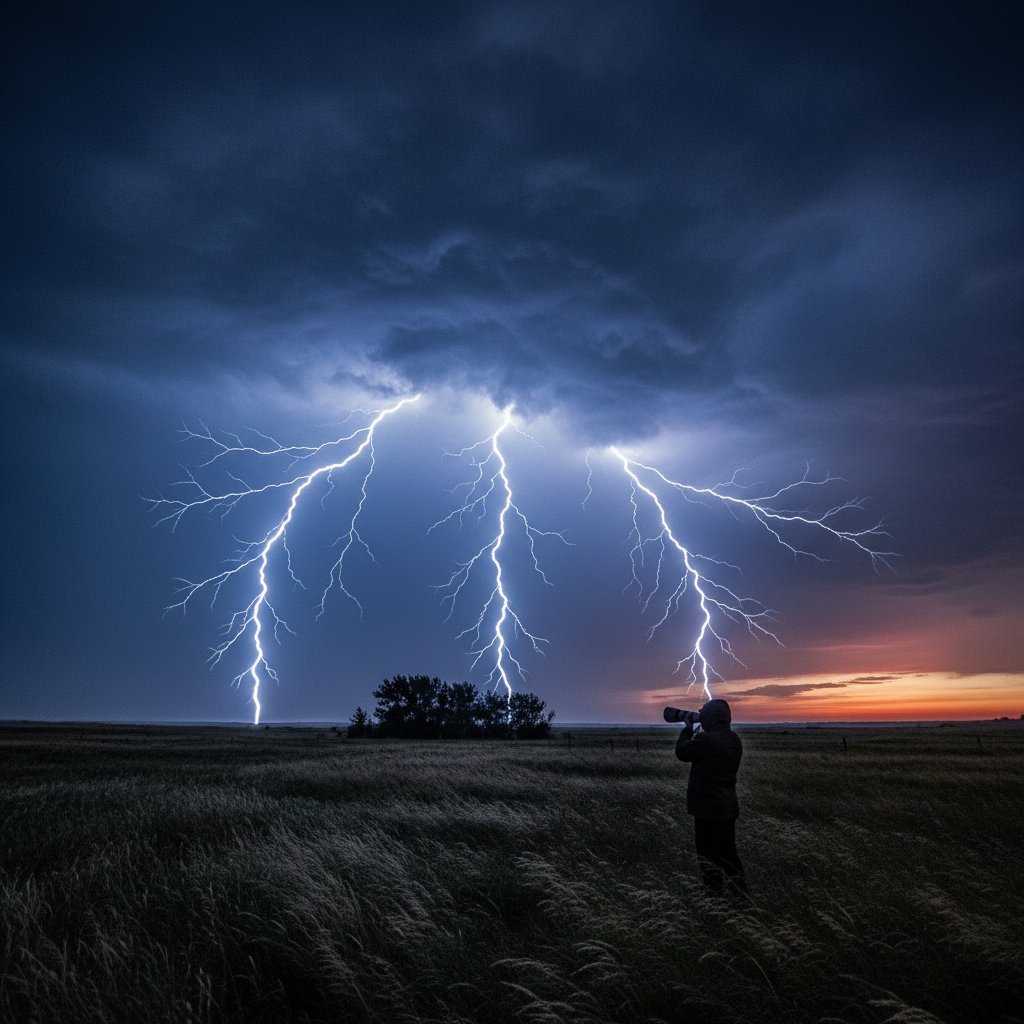
Think of it as a reconnaissance mission. The leader moves downward, pausing after each step to test the air ahead. If the ionization ahead is insufficient, it branches off into new directions, creating the tributaries that give lightning its characteristic forked appearance. Each branch is a potential route, but only one will eventually complete the circuit.
“Stepped leaders are the unsung heroes of the lightning process. Without them, the main channel would never form. Their branching structure is nature’s way of finding the optimal path under complex electrical conditions,” explains Dr. Maria Torres, a lightning physicist at the University of Florida.
First identified through high-speed photography in the 1930s, stepped leaders remain a subject of intense study. Modern instruments—like high-resolution cameras capturing 100,000 frames per second and specialized radio-frequency sensors—now reveal details Franklin could only dream of. In fact, Benjamin Franklin’s famous kite experiment in 1752 was essentially an attempt to intercept a stepped leader, though he didn’t know it by that name.
The Role of Tributary Branches
Why do stepped leaders branch at all? The answer lies in the chaotic nature of the electric field. As the leader descends, it encounters pockets of air with varying conductivity and charge density. When the field ahead is too weak to sustain further ionization, the leader’s tip splits into multiple paths, each probing a different region. These tributaries can extend for hundreds of meters, forming a dendritic network that resembles a river delta—or a root system.
Recent research published in Geophysical Research Letters (2023) used 3D mapping of lightning channels to show that the average stepped leader has between 5 and 12 major branches, though some can exceed 20. The length of each tributary correlates strongly with the local electric field strength. In storms with higher charge densities, the branching is more extensive, often producing the spectacular “forked lightning” that photographers chase.
These tributaries aren’t just dead ends. They serve a critical function: they redistribute charge along the leader, helping to sustain the electrical potential difference needed for the final strike. Moreover, some branches may later become active again if conditions shift—a phenomenon called recoil leader that can cause subsequent strokes in the same flash.
“The tributaries are not random. They follow predictable patterns based on the storm’s charge structure. If we can model their branching, we can better estimate where lightning will strike and how intense it will be,” says Dr. James Whitfield, a meteorologist at the National Center for Atmospheric Research.
Historical comparisons are illuminating. In the early 20th century, physicist Charles T. R. Wilson compared stepped leaders to the slow, creeping flow of a viscous fluid. Modern simulations treat them as a type of “electrical fracturing” of the air—a process analogous to how cracks propagate through glass. Just as a crack will fork when it hits a weak point, a stepped leader branches when the ionized path becomes unstable.
From Cloud to Ground: The Final Strike
The career of a stepped leader ends in a split second. As one of its tributaries nears the ground (or a tall structure), the electric field intensifies dramatically. This triggers an upward connecting leader from the ground—often invisible to the naked eye—that meets the descending branch. The moment they connect, a massive return stroke surges upward along the ionized path, creating the brilliant flash we see.
This final stage is why the branching matters. The exact point where the upward leader attaches determines the strike location. Buildings with lightning rods are designed to encourage that attachment at a safe point, but the tributaries can sometimes bypass the rod if they branch unexpectedly. That’s why modern lightning protection systems use multiple air terminals and a network of conductors to intercept any possible branch path.
Data from the U.S. National Lightning Detection Network shows that about 70% of cloud-to-ground strikes have at least one visible branch. In extreme cases, such as during severe thunderstorms in the Great Plains, branches can span more than 2 kilometers horizontally, creating what meteorologists call “spider lightning.” This phenomenon, captured during the 2023 derecho in Iowa, demonstrated how stepped leaders can travel long distances before finding a ground point.
For the average reader, this means that a lightning strike is rarely a simple point event. The tributaries can induce side flashes—current jumping from a struck tree or pole to a nearby person or object—even tens of meters away. This is why experts advise staying away from any isolated tall object during a storm; the invisible branches may be reaching out much farther than the visible channel.
Why This Matters for Storm Safety
Understanding stepped leaders and their tributaries has practical implications for lightning safety, infrastructure design, and even climate science. For instance, researchers at the University of São Paulo recently used stepped leader branching patterns to improve early warning algorithms for lightning initiation. By detecting the characteristic radio pulses of branches before the main stroke, they can now provide alerts 5 to 10 seconds earlier than traditional methods.
That may not sound like much, but in a thunderstorm, every second counts. Lightning kills roughly 2,000 people worldwide each year, and many of those deaths occur because people stayed outside too long, thinking the worst was over. The stepped leader process begins up to a second before the strike—meaning if you see a flash, the leader already reached the ground. But if you can detect the leader’s tributaries via radio waves, you can warn of an imminent strike before the visual flash.
Looking ahead, climate change may alter lightning patterns. Warmer temperatures increase atmospheric instability, leading to more intense thunderstorms—and potentially more stepped leaders with wider branching. A 2022 study in Science projected a 12% increase in global lightning frequency per degree Celsius of warming. That means more tributaries, more side flashes, and greater risk to life and property.
From Ben Franklin’s kite string to today’s ultra-high-speed cameras, the study of stepped leaders has come a long way. Yet the fundamental mystery remains: exactly how does a faint, branching spark decide which path to take in the chaos of a storm? The answer may hold the key to predicting lightning with precision, saving lives one tributary at a time.