





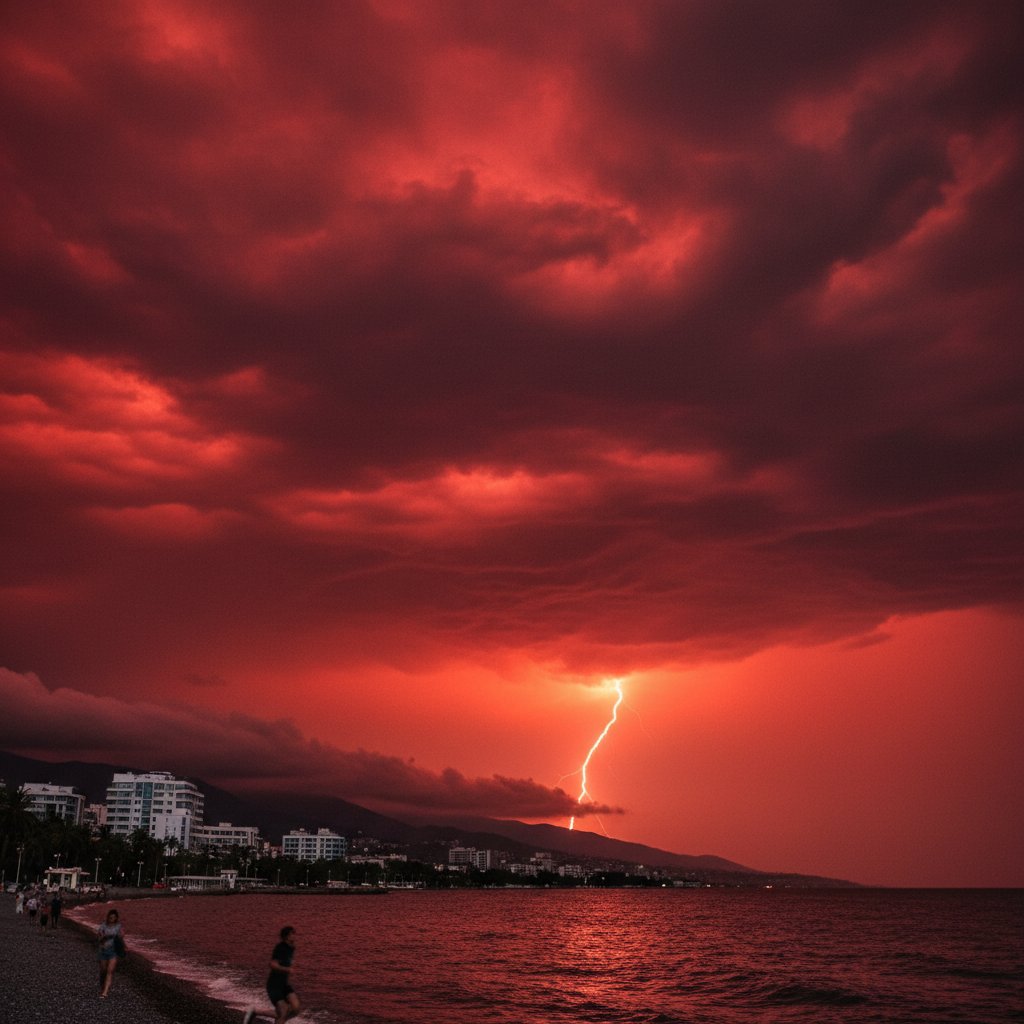
It looked like the sky had caught fire. Residents and tourists in the Black Sea resort town of Sochi looked up on the evening of March 15 to find the heavens glowing an eerie crimson, a deep orange-red that stretched from horizon to horizon. The unusual spectacle lasted nearly an hour before fading into a bruised purple twilight.
Within 12 hours, the storm that forecasters had been tracking for days arrived. Heavy rain, wind gusts exceeding 80 km/h, and rough seas lashed the coastline. A passing yacht nearly capsized; beachfront cafes scrambled to secure outdoor furniture. For those who saw the red sky, the connection was obvious: the old mariner’s adage — red sky at night, sailor’s delight — had failed them. This was no delight. It was a warning.
But was it just folklore, or is there real science behind the ruby glow? And what does this mean for the broader pattern of severe weather sweeping across Russia’s southern regions this spring?
What Causes Red Skies Before Severe Weather?
The physics is straightforward — but the context is everything. Sunlight, when it travels through the atmosphere at low angles (sunset or sunrise), scatters off particles. Blue light scatters the most, leaving the longer red wavelengths to paint the sky. That’s the standard explanation. However, the intensity of the red depends heavily on what’s floating in the air.
In Sochi’s case, a combination of high atmospheric pressure to the west and a fast-approaching low-pressure system from the Mediterranean created a perfect setup. The high pressure held a stable layer of dust and moisture over the region. As the sun dipped, its rays passed through this loaded atmosphere, scattering blue light so thoroughly that the sky turned almost blood-red. Then the low pressure pushed in, displacing the air mass and triggering severe storms.
Dr. Irina Volkov, a meteorologist at the Russian Hydrometeorological Center, confirms:
“The red sky we observed was not an anomaly. It’s a classic sign of an advancing warm front laden with moisture and particulates. In this case, the air was exceptionally dry ahead of the front, which intensified the scattering effect. But it was certainly a precursor to the instability that followed.”
This isn’t the only natural phenomenon that gives us visual cues before dangerous weather. Recent seismic activity near the Kermadec Islands reminded us that the Earth often sends subtle signals — changes in animal behavior, ground tilt, or even unusual sky colors — before major events. While sky color isn’t a reliable earthquake predictor, its link to storm dynamics is well established.
The Science Behind the Phenomenon
So why does a red sky in the evening sometimes predict fair weather and other times herald storms? The key lies in the direction of the light and the position of the weather system. The classic rhyme works best in mid-latitudes where weather moves west-to-east. A red sky at sunset means the sun’s light is coming from the west, passing through dry air that has already moved east. That usually means fair weather is approaching. But when the sun sets behind a dirty, dusty, or moisture-laden western sky — as it did over Sochi — the red deepens, and the rhyme fails.
Dr. Mark Thompson, an atmospheric scientist at the University of Cambridge, explains:
“The old rhyme is a useful rule of thumb, but it’s not a law of nature. In Sochi, the red sky was produced by a combination of Saharan dust — which had traveled thousands of kilometers — and the sharp gradient between a blocking high and an incoming low. That’s a recipe for severe weather, and the sky told the story.”
This event also highlights how global atmospheric patterns are connected. The dust that contributed to Sochi’s crimson skies likely originated from the Sahara Desert. Such long-range transport of dust is becoming more frequent due to changes in wind patterns linked to climate variability. Meanwhile, the same low-pressure system that hit Sochi later brought heavy snow to the Caucasus mountains and flash floods to parts of Georgia.
Historical and Cultural Significance
Red skies have held meaning across cultures for millennia. Biblical references, Norse myths, and Native American legends all associate crimson horizons with divine messages or impending doom. In more recent history, the 1883 eruption of Krakatoa turned skies red globally for months. But for everyday people, the red sky before a storm remains a visceral reminder that nature communicates — if we know how to read it.
In Sochi, some locals joked that the red sky was a reflection of the city’s famous neon-lit nightclubs. Others, remembering the devastating floods that hit the region in 2016 and 2021, took it seriously. Emergency services were put on alert hours before the storm hit, likely preventing property damage and potential injuries.
Could such visual cues be used more systematically in early warning systems? Just as seismologists monitor subtle tremors before large earthquakes in the Ring of Fire, meteorologists are exploring whether machine learning algorithms trained on sky color data could improve short-term storm forecasts. It’s an avenue that combines ancient observation with modern technology.
What It Means for the Region’s Weather
Sochi’s red sky was not an isolated event. Over the past month, a series of powerful cyclones have battered the Black Sea coast. The region, known for its subtropical climate, is seeing more intense and erratic weather. Sea surface temperatures in the Black Sea are running 2°C above the long-term average, providing extra energy to passing storms. The upcoming forecast suggests more unsettled weather through the end of March.
For residents, the lesson may be to trust what they see. For scientists, it’s a reminder that even in an age of satellite data and supercomputer models, the naked eye can still spot something important. Look at the sky tomorrow evening — you might just glimpse a warning.
The strange beauty of the red sky over Sochi is now gone, replaced by grey clouds and rain. But it won’t be the last time such a phenomenon appears. As global temperatures rise, the ingredients for these dramatic sunsets — dust, moisture, and volatile weather fronts — become more common. And with them, perhaps, the need to reinterpret an ancient rhyme for a new century.
Frequently Asked Questions
Is a red sky always a sign of severe weather?
No. A red sky can simply be a beautiful sunset caused by clean, dry air. The key is context: if the sky turns a deep crimson or blood-red, and the weather pattern shows an approaching low-pressure system, it can indicate incoming storms. The classic rhyme works best in temperate latitudes with predictable west-to-east storm tracks.
What causes the sky to turn red?
Sunlight scatters off particles and gas molecules in the atmosphere. This is called Rayleigh scattering. At sunrise or sunset, the light travels a longer path through the atmosphere, and shorter blue wavelengths are scattered out, leaving reds and oranges. Additional dust, pollution, or moisture can enhance the red color.
Did the red sky over Sochi help with storm preparation?
Yes. While not an official warning, the unusual sight prompted many locals and resort managers to take precautions. Emergency services had already been monitoring the forecast, but public awareness of the odd sky likely contributed to quicker responses when the storm hit. Such visual cues can complement formal warning systems.