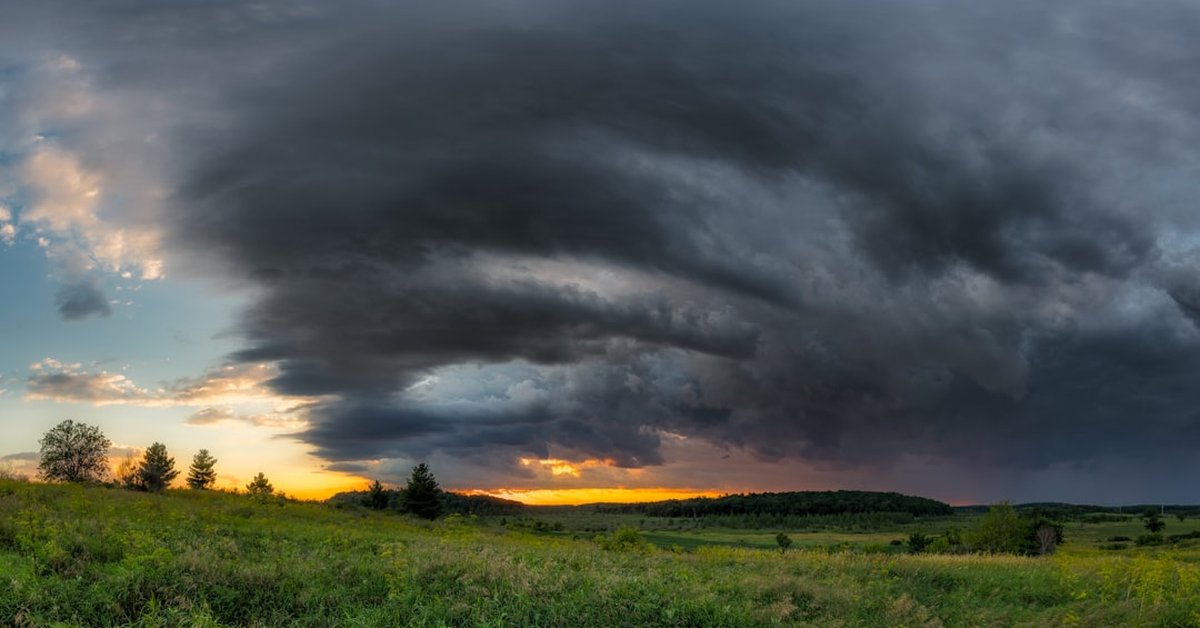







“I’ve been photographing storms for twenty years, and I’ve never seen anything quite like it—the sky looked like it was bleeding neon.”
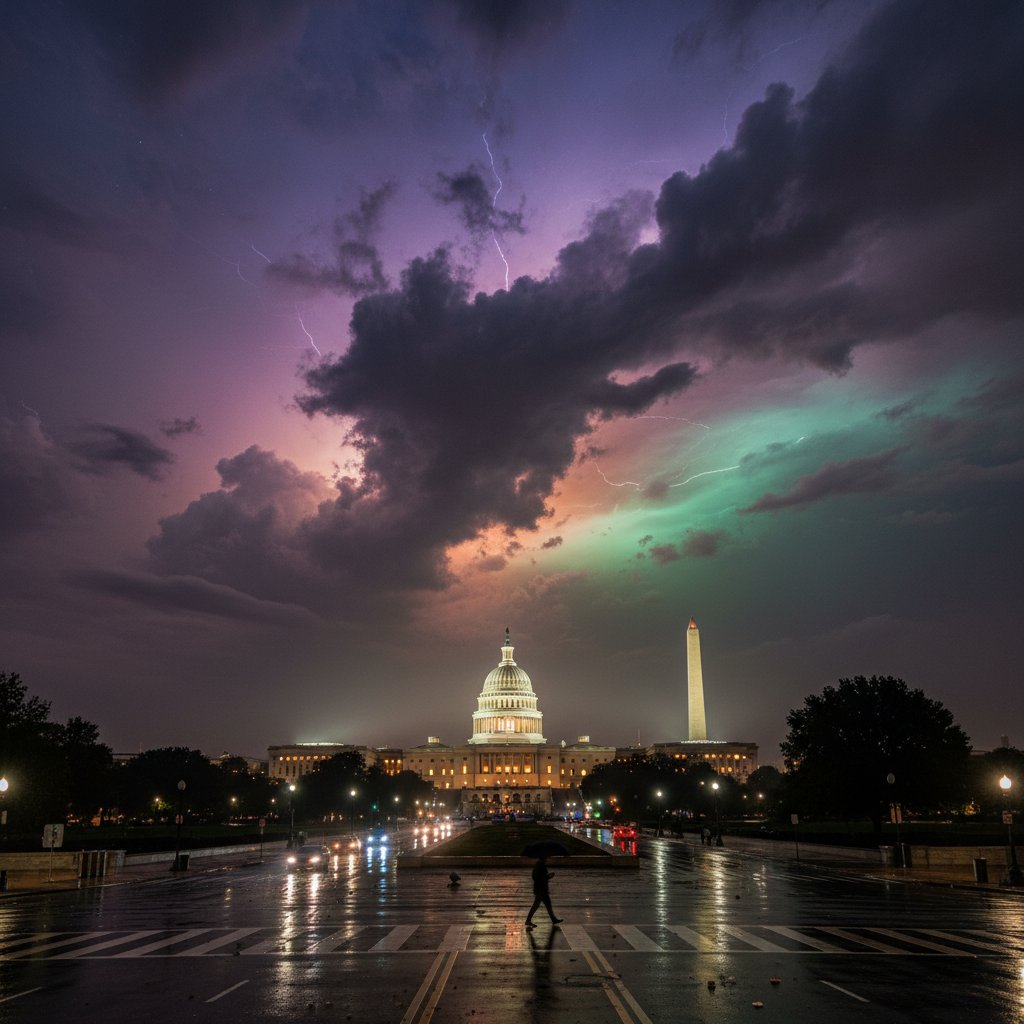
The scene was otherworldly. Just hours after a powerful line of thunderstorms swept through Washington, D.C., residents looked up to find the evening sky transformed into a canvas of electric purple, vivid magenta, and shimmering green. The spectacle, captured by dozens of photographers and shared across social media, left even seasoned meteorologists searching for words.
It was Monday, March 4, 2025, and the capital was still drying out from a storm system that had dumped over two inches of rain in less than an hour, toppled trees in Rock Creek Park, and briefly knocked out power to more than 15,000 homes in the District. But as the clouds parted around 7:30 PM, something extraordinary happened.
The sky didn’t just clear—it exploded in color.
What Causes a Storm’s Afterglow to Turn Neon?
To understand the phenomenon, we have to look at what’s left behind after a storm. “The key ingredients are residual moisture, ice crystals high in the atmosphere, and the angle of the setting sun,” explains Dr. Mark Rivera, a meteorologist with the National Weather Service in Sterling, Virginia. “In this case, the storm passed just as the sun was dipping below the horizon, and the combination of scattered light and ice particles created a prism effect.”
Scientists call this event crepuscular scattering, but the colors that appear depend on a delicate balance of particles and light wavelengths. Purple and green tints emerge when sunlight filters through water droplets and ice crystals at specific angles—usually between 5 and 10 degrees above the horizon. In D.C. on Monday, the conditions were near-perfect.
“We had a layer of high-altitude cirrus clouds left by the storm’s outflow, and the air was exceptionally clear after the rain washed out dust and pollution,” Rivera adds. “That clarity let the vibrant wavelengths—violet and green—reach the ground without being diffused by haze. It’s rare, but when it happens, it’s stunning.”
The show lasted about 20 minutes, peaking at 7:42 PM. Residents from Georgetown to Capitol Hill reported seeing the sky shift from deep purple to a soft, mint green before fading into a deep indigo.
A Night to Remember for D.C. Residents
For many in the city, the display was a moment of unexpected beauty after a tense evening. “I was checking for downed branches in my backyard when I looked up and just froze,” says Sarah Kim, a teacher living in the Adams Morgan neighborhood. “My kids were screaming about the lightning, and then suddenly we’re all just staring at this purple sky. It felt like we were on another planet.”
Kim’s experience was far from unique. The hashtag #DCPurpleSky trended briefly on X (formerly Twitter), with users sharing photos from rooftops, bridges, and the banks of the Potomac River. One image, taken near the Lincoln Memorial, showed the Reflecting Pool mirroring a lavender sky while the last streaks of orange clung to the horizon.
But the wonder came with reminders of the storm’s impact. In nearby Arlington, Virginia, flash flooding stranded several cars on I-395, and two people were treated for minor injuries after being caught in a microburst near National Airport. The storm had formed along a cold front that moved through the mid-Atlantic, and the National Weather Service had issued a severe thunderstorm warning for the District from 6:15 PM to 7:00 PM.
“The flip side of that beautiful sky is that it was born from a powerful and dangerous storm,” notes Torres. “It’s a reminder that nature’s most stunning moments often come right after its most destructive ones.”
The Science Behind the Colors: Why Purple and Green?
While sunsets often produce reds and oranges, purple and green are less common—and require specific conditions. “Red light has the longest wavelength, so it scatters easily and dominates typical sunsets,” explains Dr. Alicia Chen, a research scientist at the National Oceanic and Atmospheric Administration (NOAA). “But for purple or green to appear, you need light to pass through ice crystals that act like tiny prisms, bending the blue and violet light toward the observer. This is similar to what causes a green flash at sunset, but on a larger, more diffuse scale.”
Chen points out that the presence of thunderstorms adds another variable. “Storms push moisture and ice high into the troposphere, sometimes up to 40,000 feet. When those particles linger after the storm, they create a perfect scattering layer. The purple we saw in D.C. likely came from a combination of ice crystals and very fine water droplets—a sort of natural particle cocktail.”
The rare appearance of green in the sky is even more intriguing. “Green light has a shorter wavelength, so it’s usually absorbed or scattered before it reaches the ground,” Chen continues. “But when you have a very thin layer of uniform ice crystals—like after a storm—green can emerge. It’s fleeting, and we only saw it for about four minutes in D.C., but it was unmistakable.”
Meteorologists at the National Weather Service confirmed that no similar event has been documented in the D.C. area since August 2017, when a thunderstorm produced a brief purple afterglow near Dulles International Airport.
What This Means for Forecasters and the Public
For weather experts, such vivid natural displays are more than just beautiful—they offer clues about atmospheric conditions. “We can learn from events like this,” says Rivera. “The fact that we saw such clear, saturated colors tells us that the atmosphere was exceptionally clean after the rain, and that there was a sharp gradient in moisture and temperature aloft. That data helps us refine our models for future storms.”
But for the average person, the takeaway may be simpler. “It was a gift,” says Kim, the D.C. teacher. “After a scary hour of thunder and lightning, the sky gave us something magical. I think we all needed that.”
The National Weather Service encourages residents to submit their own photos and observations to help scientists track these rare events. As climate change alters weather patterns, such displays may become more frequent—or more rare—but for now, D.C. has a story to tell.
“We’ll be studying the data from this event for weeks,” says NOAA’s Chen. “But honestly? Sometimes science just has to take a moment and appreciate the art.”