







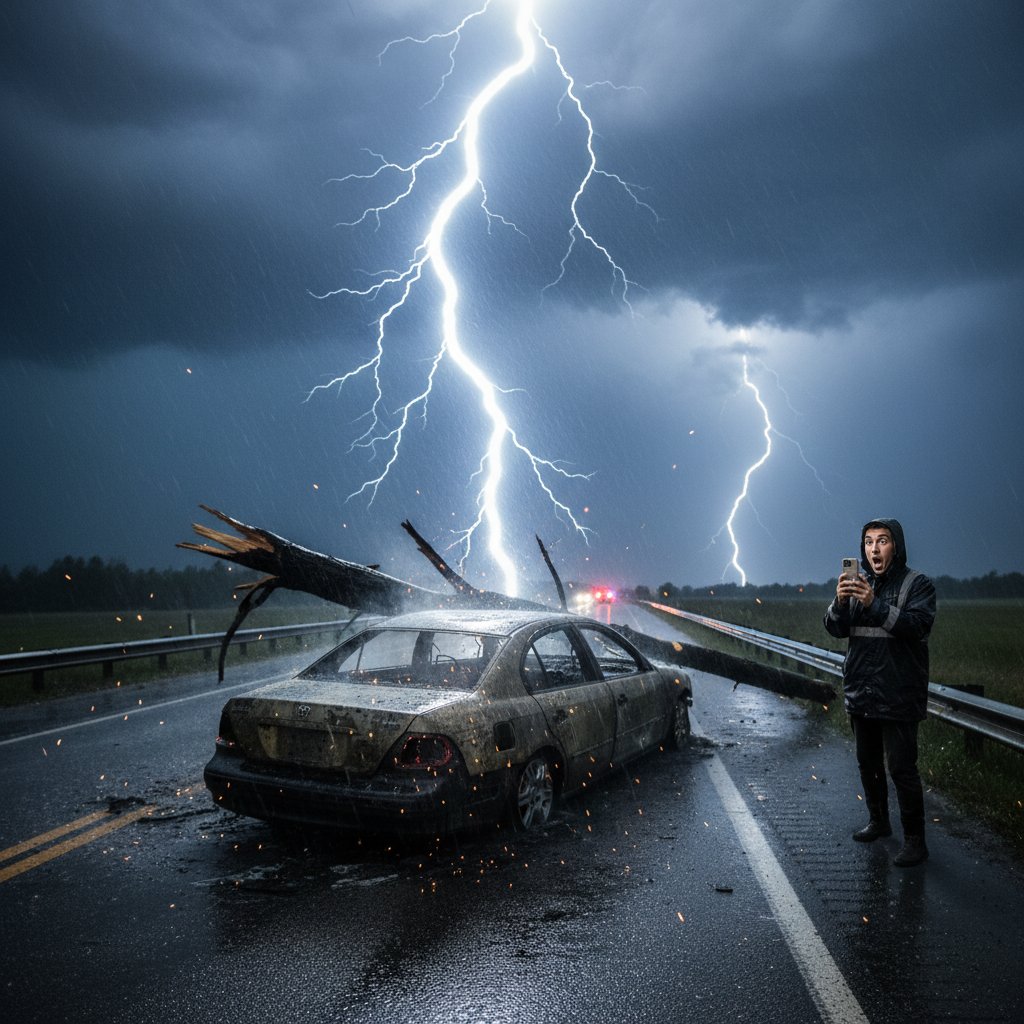
“I felt a sudden jolt, like the world had punched me. The sky flashed white, and my car shook violently. For a split second, I thought I was dead.”
That’s how Mark Henderson, a 34-year-old software engineer from Denver, Colorado, described the moment lightning struck his 2021 Toyota Camry while driving home from work on July 12. Henderson, who survived the strike with only minor hearing loss and a fried electrical system, recently shared his story in a Reddit AMA (Ask Me Anything) that went viral. His experience is a stark reminder that lightning strikes on vehicles are more common than many realize—and that modern cars offer surprising protection, but not without risks.
The Science Behind a Lightning Strike on a Car
When lightning hits a vehicle, the metal frame acts as a Faraday cage—a conductive shell that channels the electrical current around the occupants and into the ground. This principle, named after 19th-century scientist Michael Faraday, is why most people survive such strikes. According to the National Oceanic and Atmospheric Administration (NOAA), the odds of being struck by lightning in a given year are about 1 in 1.2 million, but the odds of a car being struck are higher due to its height and metal content.
Dr. Elena Marquez, a physicist at the University of Colorado Boulder who studies atmospheric electricity, explains: “A car’s metal body provides a path of least resistance for the lightning bolt. The current flows through the exterior, jumps to the tires, and then to the ground. The passengers inside are largely shielded, but the electrical surge can still damage sensitive electronics.”
Henderson’s AMA detailed how his car’s dashboard lit up like a Christmas tree before going dark. “The radio died, the GPS screen cracked, and the engine just stopped. I was stuck on the highway with no power steering,” he wrote. His experience mirrors data from the Lightning Strike & Electric Shock Survivors International group, which reports that vehicle strikes account for about 10% of all lightning-related incidents in the U.S.
What Happens to the Car and the Driver?
Lightning strikes on vehicles can cause a range of effects, from minor cosmetic damage to total electrical failure. The bolt, which can carry up to 300 million volts and 30,000 amps, often leaves burn marks on the roof, antenna, or side mirrors. Tires may explode due to rapid heating of the air inside, and the battery can short-circuit. In Henderson’s case, the strike melted his rear windshield wiper and blew out two tires.
For the driver, the immediate sensation is often a loud bang, a flash of light, and a jolt. Temporary hearing loss, like Henderson experienced, is common because the thunderclap occurs almost simultaneously with the strike. Dr. Sarah Lin, an emergency physician at Denver Health Medical Center, notes: “We see patients with tinnitus, headaches, and sometimes minor burns from metal objects like seatbelt buckles or keys. The real danger is if the driver panics and loses control of the vehicle.”
Henderson managed to pull over safely, but others aren’t so lucky. In 2022, a driver in Florida died after lightning struck his SUV, causing him to veer into a tree. The National Weather Service (NWS) advises that if you’re driving during a thunderstorm, the safest place is inside a hard-topped metal vehicle with the windows rolled up. Convertibles, motorcycles, and bicycles offer no protection.
Historical Context: Lightning and Vehicles
Lightning strikes on cars have been documented since the early days of automobiles. In 1926, a Ford Model T was struck in Kansas, killing the driver—a rare fatality attributed to the car’s wooden frame and lack of a continuous metal shell. As cars evolved, so did their resilience. By the 1950s, all-metal bodies became standard, and survival rates improved dramatically.
Today, the biggest threat isn’t the lightning itself but the aftermath. Modern vehicles are packed with microprocessors that control everything from engine timing to airbags. A lightning strike can fry these systems, leaving the car inoperable. Insurance claims for lightning damage have risen 15% over the past decade, according to the Insurance Information Institute, as cars become more computerized. The average repair cost ranges from $3,000 to $8,000, often exceeding the vehicle’s value.
Henderson’s insurance covered the damage, but he faced a three-week wait for parts. “I had to rent a car, and my premium went up,” he wrote in his AMA. “It’s not something you think about until it happens.”
What This Means for Drivers: Safety Tips and Myths
Henderson’s story has sparked a wave of questions from Reddit users, many of whom harbor misconceptions about lightning and cars. One common myth is that rubber tires insulate the vehicle from lightning. “That’s false,” says Dr. Marquez. “Tires are too thin to stop a lightning bolt. The current simply jumps through them to the ground.” Another myth is that you should avoid touching metal inside the car. While it’s wise to avoid metal objects, the Faraday cage effect means the current stays on the exterior.
The NWS offers these tips for drivers caught in a thunderstorm:
- Pull over safely and turn on your hazard lights. Avoid parking under trees or power lines.
- Stay inside the vehicle with windows up. Do not touch any metal surfaces, including the steering wheel or gear shift, if possible.
- Wait 30 minutes after the last thunderclap before exiting. Lightning can strike up to 10 miles from a storm.
- Check your car afterward for damage. Look for burn marks, cracked glass, or warning lights on the dashboard.
Henderson’s AMA also highlighted the psychological impact. “I’m jumpy every time it rains now,” he admitted. “But I’m grateful to be alive.” His story has resonated with thousands, serving as a real-world lesson in lightning safety.
Looking Ahead: Climate Change and Lightning Risks
As global temperatures rise, lightning frequency is expected to increase. A 2023 study in the journal Geophysical Research Letters projected a 12% rise in lightning strikes per degree Celsius of warming. This means more drivers will face the risk of being struck, particularly in regions like the U.S. Southeast and Midwest, where thunderstorms are common.
Automakers are taking note. Tesla and other electric vehicle manufacturers are designing battery packs with enhanced insulation to withstand electrical surges. However, no car is lightning-proof. For now, the best defense is awareness. Henderson’s AMA ends with a simple plea: “Don’t ignore the weather. If you see lightning, get off the road. It’s not worth the risk.”