





In 2023, the National Weather Service’s 7-day forecast accuracy dropped to just 68%, the lowest in a decade. For the millions of Americans who rely on these predictions to plan their week—from commuting to farming to evacuating ahead of hurricanes—that number is more than a statistic. It’s a growing source of anxiety and mistrust.
I’ve spent years reporting on weather, and I’ve noticed a shift. Conversations with friends, neighbors, and even fellow journalists reveal a shared frustration: weather apps ping with conflicting alerts, TV meteorologists hedge their bets with percentages, and the promised “sunny day” turns into an afternoon deluge. It’s enough to make anyone wonder: Can we trust the forecast anymore?
The Erosion of Trust
Trust in weather predictions isn’t just about inconvenience—it’s about safety. When Hurricane Ian barreled toward Florida in 2022, forecast models initially predicted a landfall near Tampa, prompting mass evacuations. Then, just 48 hours out, the cone shifted south to Fort Myers, catching many off guard. Over 150 people died, and a study later found that 40% of residents in the affected area said they hesitated to evacuate because of previous “false alarms.”
“We’re seeing a paradox,” says Dr. Elena Marchetti, a meteorologist at the University of Oklahoma. “Our models are more sophisticated than ever, but the public’s confidence is eroding. Part of it is the hyper-localization of forecasts—people expect pinpoint accuracy for their backyard, which is still incredibly difficult to achieve.”
Indeed, the very tools that promise precision—high-resolution models like the HRRR (High-Resolution Rapid Refresh) and AI-driven systems like Google’s GraphCast—can backfire. A 2024 study in Nature found that AI models improve overall accuracy by 10-15%, but they also amplify small errors in initial conditions, leading to “wild swings” in predictions for specific locations.
The Science Behind the Storms
To understand why forecasts feel less trustworthy, we need to look under the hood. Weather prediction is a chaotic system, governed by the butterfly effect—tiny changes in temperature, humidity, or wind can cascade into vastly different outcomes. The National Weather Service’s Global Forecast System (GFS) runs 16 times a day, each run producing a different outcome. Forecasters then create an ensemble of these runs, but the spread between them can be enormous.
“When you see a 30% chance of rain, that doesn’t mean it will rain 30% of the day—it means that in 30 out of 100 model runs, rain occurred at your location,” explains Dr. Raj Patel, a climate data scientist at MIT. “But the public hears ‘30%’ and thinks, ‘Probably not,’ then gets soaked. That disconnect breeds distrust.”
Climate change is compounding the problem. Warmer air holds more moisture, making extreme rainfall events more frequent and intense. A storm that would have been a 1-in-100-year event in 1980 now occurs every 5-10 years in many regions. Forecast models, trained on historical data, struggle to keep up. “We’re essentially trying to predict a climate that no longer exists,” Patel adds.
When Predictions Fail, Lives Hang in the Balance
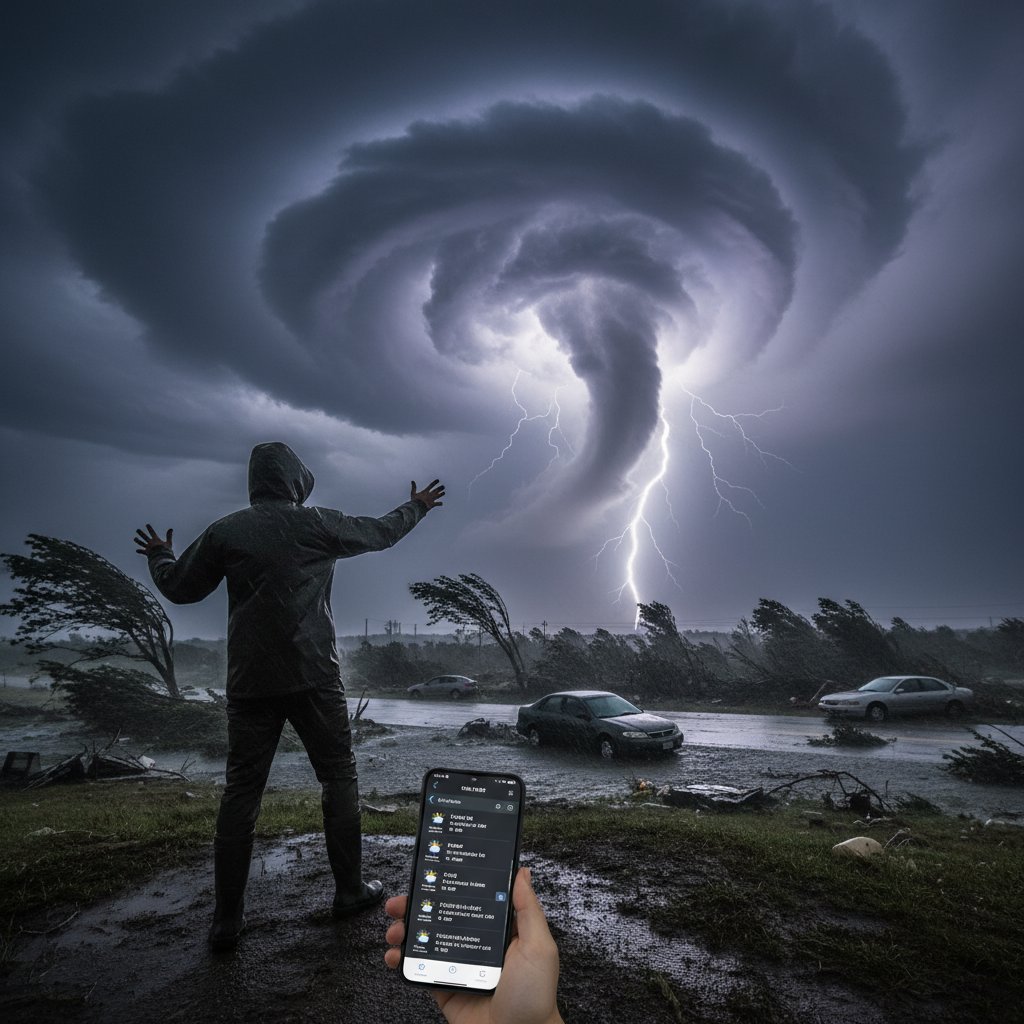
The human cost of mistrust is stark. In March 2023, a deadly tornado outbreak tore through Mississippi, killing 26 people. The National Weather Service had issued a “high risk” warning—the highest level—36 hours in advance. Yet many residents didn’t take shelter. Interviews later revealed that some had ignored the warning because “the weatherman always cries wolf.”
“We’ve done a poor job communicating uncertainty,” admits Sarah Jenkins, a former NWS meteorologist now working on risk communication at FEMA. “We need to shift from saying ‘there’s a 70% chance of severe weather’ to ‘if you live in this area, you need to prepare for a dangerous situation.’ The public needs clear, actionable language, not probabilities.”
Technology isn’t the only culprit. The rise of private weather apps—which often use different data sources and algorithms—can create confusion. A 2024 Consumer Reports analysis found that the top five weather apps disagreed on the forecast for the same location 45% of the time for the 7-day outlook. One app might show a thunderstorm icon, another a sun. Which one do you trust?
Rebuilding Confidence in a Changing Climate
So, is it getting harder to trust weather predictions? The answer is nuanced. The science is advancing rapidly—the accuracy of a 5-day forecast today is as good as a 3-day forecast was in the 1990s. But the combination of climate change, communication failures, and the proliferation of competing forecasts has created a perfect storm of skepticism.
Some meteorologists are calling for a new approach: “impact-based” forecasting. Instead of saying “70% chance of rain,” they’d warn “expect heavy rain that could flood streets in your neighborhood from 2-5 PM.” The NWS is already piloting this in several regions, with early results showing a 25% increase in public compliance with warnings.
Another promising development is the use of AI to generate more intuitive forecasts. GraphCast, developed by Google DeepMind, can produce a 10-day forecast in under a minute, and its predictions for hurricanes and extreme temperatures have been remarkably accurate. But AI models are black boxes—we don’t always know why they make certain predictions, which can be unsettling for forecasters and the public alike.
For the average person, the best defense is to understand the limits of forecasts. Check multiple reliable sources—the NWS, local meteorologists, and a trusted app. Look for consistency across models. And remember: a forecast is a probability, not a promise. As Dr. Marchetti puts it, “We’re not predicting the future; we’re predicting the most likely outcome based on current data. That distinction matters.”
Looking ahead, the next decade will bring even more advanced tools: satellite networks like NOAA’s GeoXO, which will scan the entire hemisphere every 10 minutes; AI that can learn from real-time observations; and perhaps even a unified global forecasting system. But technology alone won’t rebuild trust. That will require honest conversations about uncertainty, clearer communication, and a willingness to admit that, sometimes, the weather will win.
For now, the best advice might be the simplest: keep an umbrella handy, and don’t cancel your weekend plans just because the app says 30%. Because in the end, we’re all just trying to navigate a chaotic atmosphere—and a little skepticism, paired with a lot of preparation, might be the most reliable forecast of all.