







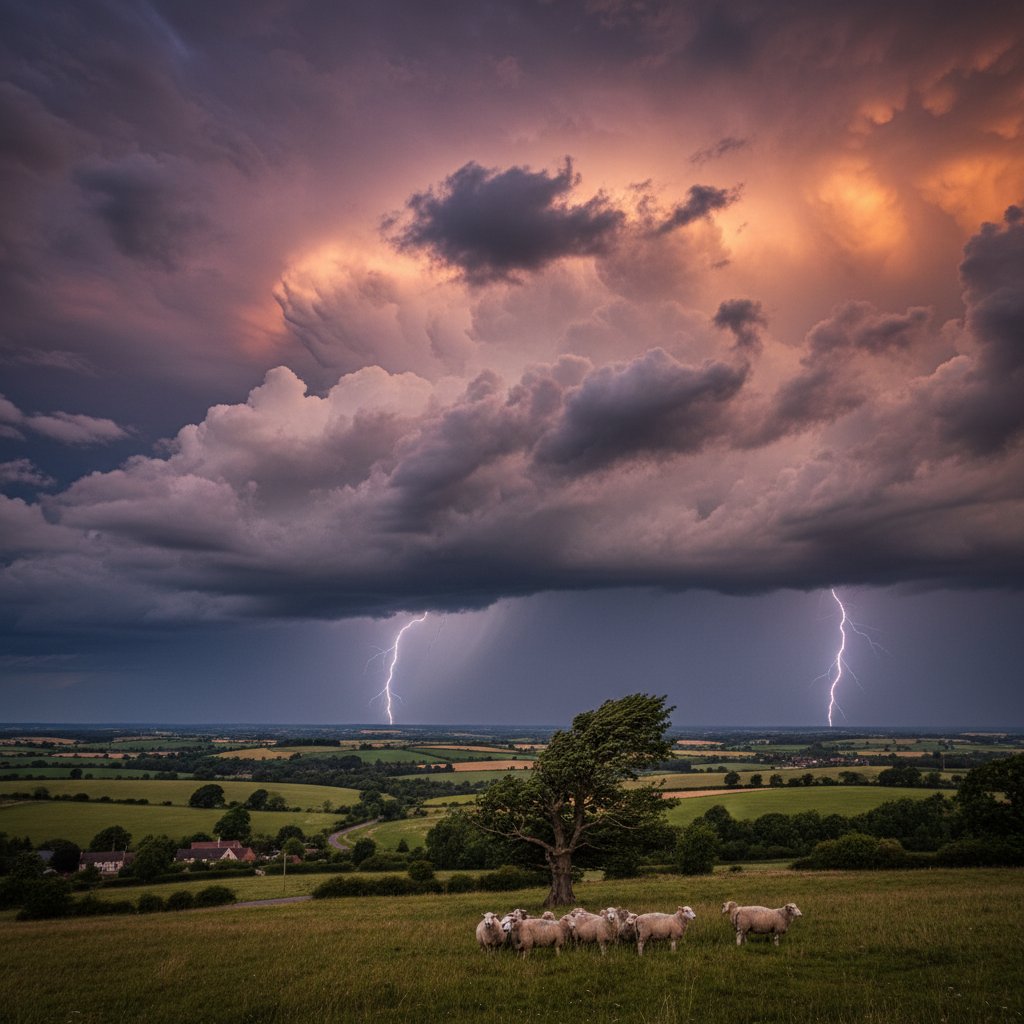
“This was a textbook elevated thunderstorm event, but the lightning density we observed over such a confined area was exceptional for the UK in early autumn.”
Dr. Alistair Finch, Senior Meteorologist at the UK Met Office, described the system that moved across central England two days ago. The thunderstorm, which developed rapidly over the Midlands, produced 1,200 cloud-to-ground lightning strikes within a two-hour window, according to preliminary data from the Met Office’s lightning detection network.
Storm Timeline and Impact
The thunderstorm formed along a stationary front draped across central England, with the initial cells developing around 14:00 UTC on Thursday near coordinates 52.5°N, 1.5°W—roughly 10 miles east of Coventry. By 14:30 UTC, the system had intensified, producing frequent lightning and moderate to heavy rainfall across a 30-mile-wide corridor.
Peak activity occurred between 15:00 and 16:00 UTC, when the storm’s core hovered over Warwickshire and Leicestershire. The Met Office’s radar data indicates rainfall rates reached 35 mm per hour at the storm’s apex, though total accumulations remained modest—between 15 and 25 mm across most affected areas.
Wind gusts were less severe, topping out at 45 mph at Birmingham Airport, but the primary threat was lightning. Emergency services reported a structure fire in Banbury after a strike ignited a residential roof, and three separate lightning-related power outages affected approximately 1,200 homes in the Northamptonshire region.
“The lightning frequency we saw was unusual for a non-frontal system in the UK,” said Dr. Finch. “This storm had characteristics more commonly seen over the US Plains in spring, though with much lower instability values.”
Meteorological Context
The UK typically averages 200,000 to 300,000 lightning strikes annually, with most occurring between May and September. However, central England experiences relatively infrequent thunderstorm activity compared to southern and eastern regions, with an average of just 8 to 12 thunder days per year.
Thursday’s event was driven by a combination of factors: a pool of cold air at 500 hPa (approximately 5.5 km altitude) with temperatures around -12°C, overspreading warmer, moist air near the surface. The lifted index was calculated at -4, indicating moderate instability, while CAPE values reached 800 J/kg—modest by global standards but significant for the region.
This setup aligns with what meteorologists call an “elevated thunderstorm,” where convection initiates above the boundary layer rather than from surface heating alone. The storm’s relatively slow movement—around 15 mph east-northeast—allowed it to persist over the same areas for nearly three hours.
“The storm’s slow propagation was key,” explained Dr. Emma Whitfield, Thunderstorm Specialist at the University of Manchester. “When a thunderstorm stalls or moves slowly, the lightning exposure risk multiplies. In this case, the cell maintained its intensity because the inflow of warm, moist air at low levels remained steady.”
Dr. Whitfield noted that climate models suggest a slight increase in thunderstorm frequency for central England by mid-century, though the signal remains uncertain. “We need more high-resolution studies to confirm trends,” she added. “But events like this provide valuable data points.”
Safety and Preparedness
For residents in central England, Thursday’s storm served as a reminder of the dangers posed by lightning, even in regions where such events are rare. The National Lightning Safety Council reports that the UK sees an average of 2 to 3 lightning-related fatalities each year, with many injuries occurring outdoors during recreational activities.
Key safety protocols include seeking substantial shelter—a building with plumbing and wiring—or a hard-topped metal vehicle when thunder is heard within 30 seconds of a lightning flash. The storm prompted a temporary closure of outdoor events in Leicester, including a university football match, and several parks in Birmingham advised visitors to move indoors.
Power companies reported restoration times of 2 to 4 hours for most outages, with all services back online by 21:00 UTC. The fire in Banbury was contained within 30 minutes, with no injuries reported.
For commuters, the storm caused minor delays on rail services near Northampton, where lightning struck signal equipment, but no major disruptions were recorded. The M1 motorway saw reduced speeds due to heavy rain, but flooding was limited to minor surface water on roads.
Looking Ahead
The same upper-level trough responsible for Thursday’s storm is expected to drift eastward over the next 48 hours, bringing a chance of showers and isolated thunderstorms to East Anglia and southeast England. However, instability is forecast to decrease, and no severe weather is anticipated.
Long-range models suggest a transition to more settled conditions by early next week, as high pressure builds from the Atlantic. For meteorologists, the storm will be analyzed in detail over the coming weeks, with the Met Office planning a case study to refine lightning prediction algorithms for the UK.
Dr. Finch emphasized the importance of continued investment in observation networks. “Events like this underscore the need for high-density lightning detection and rapid data dissemination. Our network now detects 95% of all cloud-to-ground strikes, but improving lead time for specific locations remains a priority.”
For central England, Thursday’s thunderstorm will be remembered as a stark reminder that even mild systems can carry significant hazards. As the climate evolves, understanding the dynamics behind these events becomes not just academic, but essential for public safety.