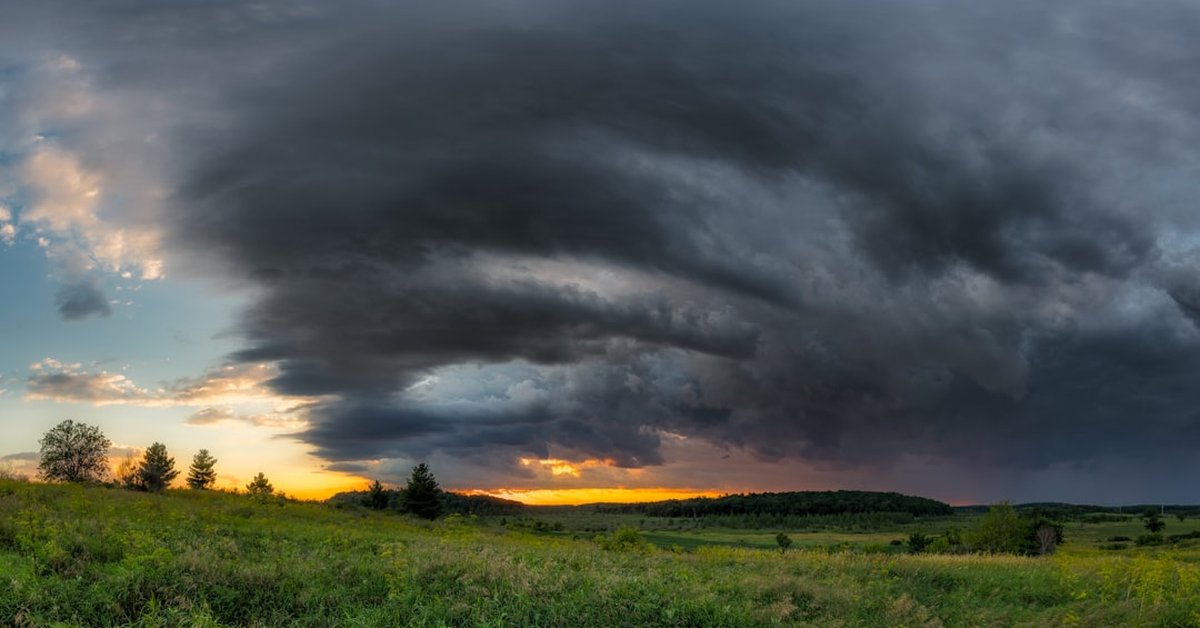






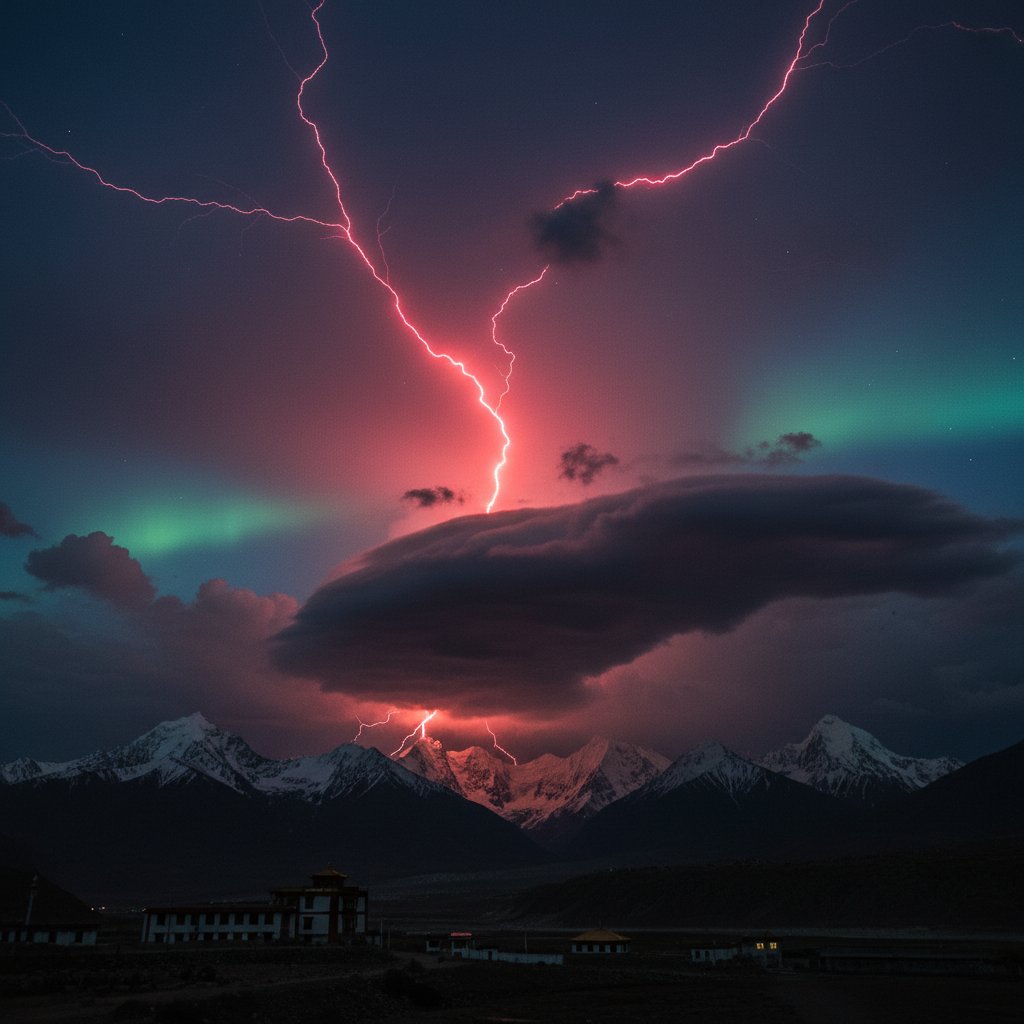
The sky above the Tibetan Plateau turned electric red for a few fleeting seconds. High above a thunderstorm that rumbled near the remote town of Nagqu, a cluster of jellyfish-like tendrils of crimson light erupted upward into the mesosphere, then vanished. It was a display of red sprites—one of the most elusive and captivating atmospheric phenomena on Earth—and it was captured on camera by a team of storm chasers on the night of October 12, 2024.
For the handful of researchers who study these transient luminous events, the sighting is a treasure. For the rest of us, it is a reminder that the sky above our heads is far more active—and far more mysterious—than we often imagine.
A Rare Sight Over the Roof of the World
The images, taken from a makeshift observation post at an elevation of 4,700 meters on the Tibetan Plateau, show at least seven individual sprites flickering above a powerful thunderstorm cell. The storm itself was part of the Asian monsoon system, which brings moisture and instability to the region during late summer and early autumn.
“We were chasing thunderstorms for weeks, hoping to catch sprites,” said Li Wei, an atmospheric physicist at the Chinese Academy of Sciences who led the expedition. “To see them at such a high altitude, with the thin, cold air of the plateau, was extraordinary. It tells us that sprites can form under conditions we didn’t fully understand.”
The event was recorded using high-speed cameras and low-light sensors. The team also deployed a small balloon-borne instrument to measure electric fields in the stratosphere. Preliminary data suggest the sprites reached heights of 80 kilometers above the storm, with each tendril stretching for tens of kilometers.
What Are Red Sprites? The Science Behind the Show
Red sprites are large-scale electrical discharges that occur high above thunderstorms, typically between 50 and 90 kilometers in altitude. They are triggered by powerful positive cloud-to-ground lightning strokes that create a sudden change in the electric field above the storm. The result is a burst of reddish light—often shaped like jellyfish, carrots, or columns—that lasts only a few milliseconds.
First documented by scientists in 1989 after decades of anecdotal reports from pilots, sprites remain difficult to study because they are rare, short-lived, and often obscured by cloud cover. Most observations come from aircraft, space stations, or dedicated ground stations in places like the Great Plains of the United States or the South American Pampas.
“Sprites are not just beautiful—they are a window into the electrical coupling between the troposphere and the ionosphere,” explained Sarah Thompson, a lightning researcher at the University of Colorado Boulder. “Every new sighting helps us refine models of how energy moves through the atmosphere.”
Thompson notes that the Tibet sighting is especially valuable because it occurred at a high altitude, where the air density is lower than in typical sprite-producing regions. “The conditions there are analogous to the upper reaches of the atmosphere. Observing sprites in Tibet could help us understand how they might behave on other planets with thin atmospheres, like Mars,” she said.
Why Tibet? The Perfect Conditions for Sprites
The Tibetan Plateau, often called the “Third Pole,” is the highest and largest plateau on Earth, with an average elevation over 4,500 meters. Its thin, dry air and intense solar heating create unique atmospheric dynamics. During the monsoon season, strong thunderstorms develop, and the reduced air density at the plateau’s elevation means that sprite formation may require less electric field strength than at sea level.
This makes the region a natural laboratory for sprite research. In fact, the 2024 sighting is not the first recorded over Tibet. A team of Chinese scientists spotted sprites there in 2022, but those events were smaller and less well-documented. The new observations are the most detailed yet, thanks to improved equipment and the persistence of researchers willing to endure the harsh conditions.
“Standing at 5,000 meters, with oxygen tanks and -20°C temperatures, waiting for a flash that may never come—that’s the reality of sprite hunting,” said Li Wei. “But when it happens, the entire sky lights up. It’s worth every frozen finger.”
The location also offers a logistical advantage: the clean, dark skies above Tibet have minimal light pollution, making it easier to detect the faint red glow of sprites. Future plans include setting up a permanent observatory on the plateau to monitor sprite activity throughout the monsoon season.
Implications for Storm Science and Climate
Beyond their visual spectacle, red sprites have practical significance. They are known to influence the chemistry of the upper atmosphere, producing oxides of nitrogen that can affect ozone levels. Understanding where and when sprites occur helps climate modelers refine their predictions of atmospheric composition.
“Right now, most climate models treat sprites as negligible, but we’re learning they may play a small but important role in the global nitrogen cycle,” said Thompson. “With more data points like the Tibet sighting, we can start to quantify that impact.”
There is also a connection to severe weather forecasting. Because sprites are triggered by intense lightning strokes, their occurrence can serve as a proxy for the strength of a thunderstorm. In the future, satellites equipped with sprite-detecting cameras could help forecasters identify rapidly intensifying storms from space.
The Tibet event has already sparked interest among space agencies. Both NASA and the European Space Agency have plans to include sprite-monitoring instruments on upcoming storm-observing satellite missions. Meanwhile, private organizations like the International Center for Lightning Research are funding field campaigns to other high-altitude regions, including the Andes and the Ethiopian Highlands.
For now, the red sprites over Tibet remain a rare and fleeting gift. But as technology improves and scientific curiosity grows, these silent explosions above the clouds may soon become less mysterious—and more integrated into our understanding of Earth’s atmospheric engine.
What comes next? The researchers who captured the October 12 event are already analyzing the data, hoping to publish their findings by early 2025. They also plan to return to Tibet next monsoon season with an array of instruments, including a drone that can fly close to the tops of thunderstorms. The skies over the Roof of the World, it seems, still have many secrets to show us.