






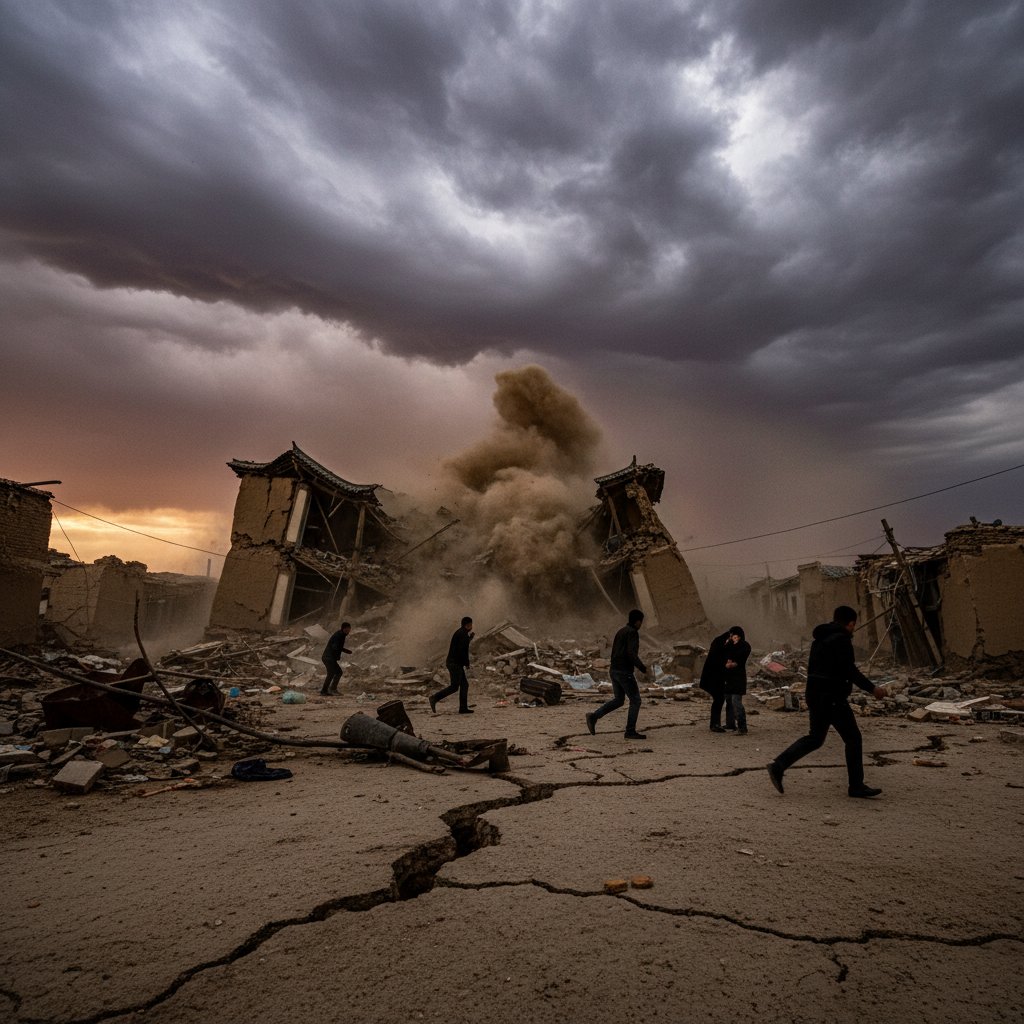
“It felt like a giant hand grabbed the ground and shook it for a few seconds—then everything went still,” said Dr. Li Wei, a seismologist at the China Earthquake Networks Center, describing the M5.0 earthquake that struck northern Xinjiang at 06:55 UTC on Friday.
For residents of Altay, a city nestled against the Altai Mountains, the tremor was a sudden, unwelcome visitor. Many rushed outside as windows rattled and picture frames swayed. In a region where silence often reigns over vast, sparsely populated landscapes, the quake was a stark reminder of the powerful forces churning beneath the Earth’s surface.
The earthquake, initially estimated at magnitude 5.0, struck approximately 40 kilometers north of Altay at a depth of 10 kilometers, according to preliminary data from the China Earthquake Networks Center. The epicenter lay in a remote area of the Junggar Basin, far from major population centers. But even a moderate shake can rattle a region unaccustomed to frequent seismic activity.
A Sudden Jolt in the Silence
Kazakh herder Arman Turgunov was tending his flock near the epicenter when the ground began to undulate. “At first I thought it was a truck, but there are no roads here,” he recalled. “Then the earth rolled like waves on a lake.” He and his family spent the next hour in the open, waiting for the aftershocks that, fortunately, never came with significant force.
Local authorities quickly initiated emergency protocols. Emergency management officials from Altay Prefecture reported that initial surveys showed no casualties and only minor structural damage—cracked walls in a few older buildings and fallen goods in shops. “Given the remote location and sparse population, the impact was limited,” said Mr. Zhang Wei, deputy director of the Altay Emergency Management Bureau. “We are continuing to monitor and have dispatched teams to the most isolated villages.”
The event occurred at 14:55 local time, catching many during their afternoon routines. Schools and factories paused as alert systems, though limited in rural areas, triggered warnings on some mobile phones. In Altay city, the tremor lasted about 15 seconds, long enough to leave residents with a lingering unease.
Tectonic Forces at Work
Northern Xinjiang sits at the boundary of several tectonic plates, including the Indian Plate, which continues to push northward into Eurasia. This collision has created the towering Himalayas and, further north, the Tien Shan and Altai mountain ranges. Xinjiang is known for moderate to large earthquakes, though the frequency is lower than in the country’s southwestern provinces.
Dr. Emma Chen, a geophysicist from the University of Hong Kong who studies the region, explained the dynamics: “The Altai region is under compression from the ongoing collision. Faults here are capable of generating quakes up to magnitude 7, but events of this size—around magnitude 5—are not uncommon. They relieve stress in the crust, but also serve as a reminder that larger events are possible.”
The earthquake’s depth—10 kilometers—is typical for crustal faulting in the area. Shallow earthquakes like this are often more damaging because energy dissipates quickly, but the remote location and primarily single-story buildings mitigated harm. Still, seismic experts warn that even a modest event can trigger landslides or rockfalls in the steep Altai valleys.
“This quake likely occurred on a northwest-southeast trending fault, the same system that produced a magnitude 6.2 event in 2012 near the same area,” noted Dr. Li Wei. “The pattern of seismicity here suggests we should expect aftershocks in the coming days, but they will mostly be below magnitude 4.”
Human Impact in a Remote Land
Northern Xinjiang is home to a mosaic of ethnic groups, including Uyghurs, Kazakhs, Han Chinese, and Mongols. Many live in small villages or lead nomadic pastoral lives. For them, an earthquake is not only a moment of fear but also a logistical challenge. Roads can be blocked by snow or debris, communication networks are sparse, and medical facilities are far apart.
In the immediate aftermath, local cadres and volunteer teams fanned out to check on isolated herder settlements. The government’s Rapid Disaster Response Unit, a national entity comprising geological and emergency experts, arrived within hours via helicopter. By evening, they had inspected the most vulnerable areas near the epicenter, including the towns of Qiemo and Fuhai.
For those in Altay city, the event sparked conversations about preparedness. “We don’t think about earthquakes often here,” said shopkeeper Ailin Zhang, standing outside her store as workers packed spilled goods. “Now I’m going to check our emergency kit. Better safe than sorry.” Her sentiment underscored a broader truth: in a region where wildfires and floods are more common threats, earthquakes can catch communities off guard.
The psychological toll, while not immediately measurable, is real. “After a sudden shake, people feel vulnerable for weeks,” said Dr. Liu Hong, a psychologist who has worked with disaster survivors in China. “Disturbed sleep, anxiety—these are normal. Community support and clear information from authorities are key to recovery.”
What Lies Ahead
Seismologists have deployed portable monitoring stations around the epicenter to track aftershock sequences. The China Earthquake Networks Center has issued a statement that “no significant seismic activity is expected above magnitude 5 in the short term,” but caution is warranted. In the broader context, this earthquake adds to a year of moderate but notable quakes in Central Asia, including a magnitude 6.7 in Kyrgyzstan earlier this year.
For residents of northern Xinjiang, the earth’s rumble will likely fade into memory unless another, stronger tremor follows. But for scientists, each event is a data point that refines understanding of a complex and poorly understood region. “Xinjiang’s faults are not as well monitored as those in Sichuan or Yunnan,” said Dr. Chen. “Every earthquake helps us fill the gaps. It’s a reminder that plate tectonics never rests—and neither should our vigilance.”
As the sun set over the Altai Mountains, the herders returned to their yurts, and the city lights of Altay flickered back to normal. No deaths. No catastrophic damage. Just a story to tell around dinner tables—a moderate earthquake that, for a few seconds, shook a remote corner of the world and left an indelible mark on those who felt it.