






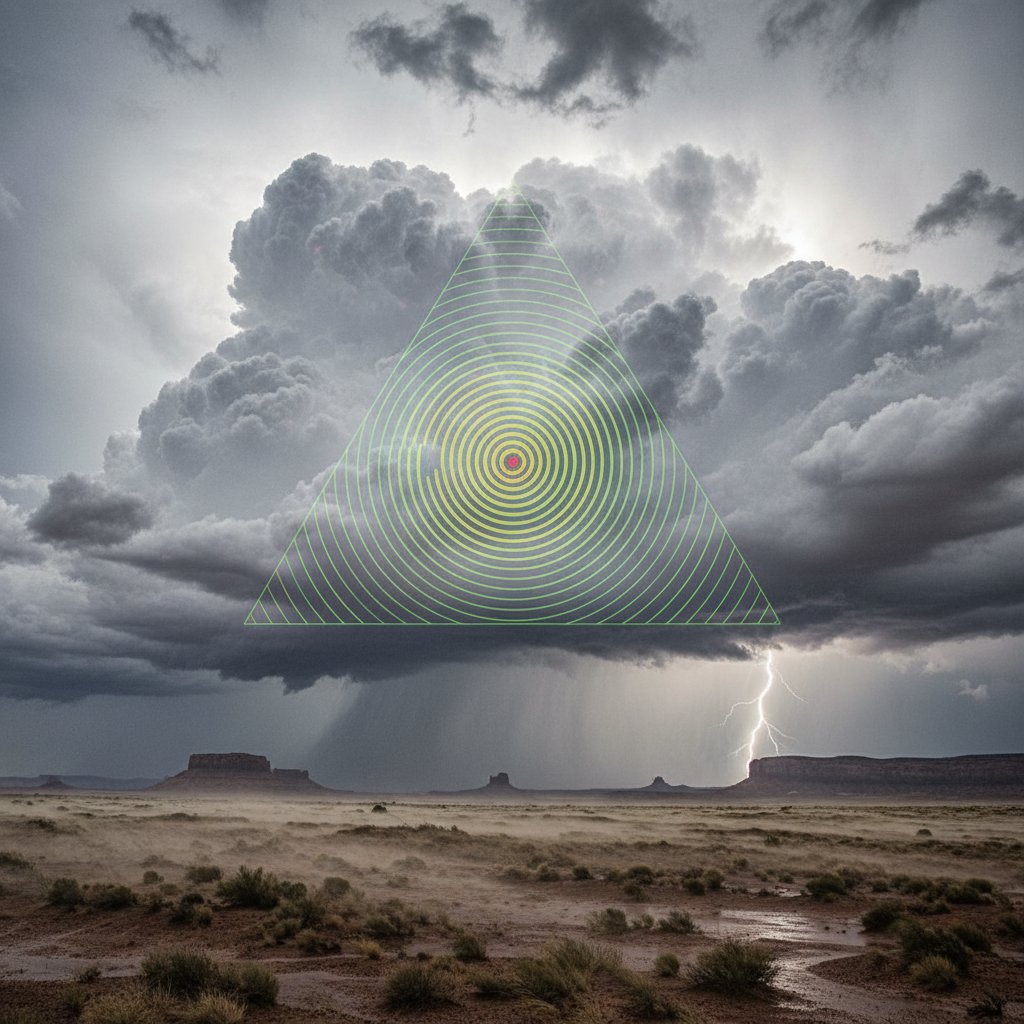
On a quiet afternoon in late February, something strange flickered across National Weather Service radar screens in Albuquerque, New Mexico. A crisp, perfectly triangular patch of reflectivity—about 20 miles across—appeared over the desert southwest of the city, lingered for nearly 90 minutes, then vanished as suddenly as it arrived. No thunderstorms, no wildfire smoke, no flocks of birds could explain it. For locals glued to weather apps and Twitter, the question was instant: What is that triangle?
The answer, according to meteorologists who studied the data, is a rare but fascinating example of a reflectivity glitch—an artifact of the radar signal bending or bouncing off something unexpected. But the triangle’s geometric precision, its sharp edges, and its stubborn persistence have turned a routine technical quirk into a viral mystery.
The Signal That Shouldn’t Exist
Radar works by sending out pulses of microwave energy and measuring how long they take to bounce back. Rain, hail, snow, dust, and even insects can produce returns. But when a radar beam catches something like a wind farm, a mountain ridge, or an anomalous propagation layer in the atmosphere, the resulting echoes can create strange shapes—blobs, streaks, or rings. Triangles, however, are exceptionally rare.
“I’ve been doing this for 15 years, and I’ve never seen a perfect triangle on base reflectivity,” says Dr. Elena Torres, a radar specialist at the Cooperative Institute for Research in the Atmosphere (CIRA). “It’s almost like the radar was painting a specific object, but the shape is too uniform for any natural phenomenon.”
Torres explains that the most likely culprit is ground clutter combined with an atmospheric duct that bent the radar beam downward. The triangle’s edges align almost exactly with a series of mesas and ridges near the Continental Divide—but that alone doesn’t explain why the shape appeared only at that specific time on that specific day. “We’re looking at real-time data, but we can’t rule out a temporary calibration issue with that particular radar site,” she adds.
New Mexico’s Radar History: A Spotty Record
New Mexico’s radar network has long been a challenge for forecasters. The state’s mountainous terrain creates frequent blockage zones, and the dry air means many storms are too shallow to be detected effectively. In 2023, the NWS in Albuquerque issued a public note about “spurious returns” from the Sandia Peak radar—a site that has been plagued by interference from nearby communications towers. But the triangular artifact is different.
Local storm chaser Miguel Otero was one of the first to tweet the image. “I thought someone had photoshopped a pyramid into the loop,” he says. “Within hours, my feed was full of guesses—UFOs, secret military tests, even a glitch in the Matrix. The NWS had to put out a statement saying it was just a radar anomaly, but honestly, they seemed as puzzled as everyone else.”
The agency’s statement, released that evening, noted that the shape “does not correspond to any known precipitation or biological activity,” and that engineers were reviewing the radar’s data log. No further explanation has been issued.
Artifacts, Anomalies, and the Art of Radar Interpretation
Radar glitches are more common than most people realize. Every meteorologist learns to recognize the most frequent culprits: sun spikes that occur at sunrise and sunset, interference from military radar, “ghost” echoes from distant storms, and ring-shaped artifacts caused by chaff (metallic strips used for defense). Triangular shapes, however, are so unusual that they often go unreported—until they go viral.
“The human brain is wired to find patterns, especially triangles,” says Dr. Samuel Okonkwo, an atmospheric scientist at the University of Oklahoma who studies radar artifacts. “But in this case, the pattern is almost certainly a result of the radar beam interacting with a man-made structure or a sharp terrain feature. The hardest part is proving which one.”
Okonkwo notes that similar triangles have been spotted before—most famously near the Arecibo Observatory in Puerto Rico before its collapse, and occasionally near large solar farms that tilt panels to follow the sun. New Mexico, with its vast arrays of solar panels and wind turbines, fits that profile. “But we need to correlate the timing with the sun’s position that day,” he cautions. “It could be a perfect alignment of geometry and solar angle.”
The triangle’s appearance lasted from 3:15 p.m. to 4:42 p.m. local time—a window that does line up with the sun’s afternoon arc across the southwestern sky. Yet the NWS has not confirmed whether a solar farm was the culprit.
What This Means for the Rest of Us
While the triangle is a visual curiosity, it highlights a deeper issue: radar data is not infallible. Forecasters must constantly filter out noise, especially in regions like the Rocky Mountain West where complex terrain and dry climates produce weak returns. For the public, the lesson is to look beyond the colorful blobs on a radar loop—especially when they seem too perfect to be real.
“The temptation to think something mysterious is going on is strong,” says Otero. “But every time there’s a weird radar image, it turns out to be insects, birds, or a glitch. The triangle was fun to speculate about, but it’s not a sign of aliens—it’s a sign that we need better radar calibration.”
The NWS will continue to analyze the data, and engineers may deploy a portable radar to test for local interference. In the meantime, the triangle has become a teaching moment. Meteorology students at the University of New Mexico are now using the image in their radar interpretation classes.
Looking ahead, new dual-polarization radars and artificial intelligence–based filtering tools may reduce such glitches in the future. But for now, the desert of New Mexico keeps a secret—or at least a strange, triangular fingerprint that reminds us that even the most advanced technology can still be tricked by a little sunlight, a little terrain, and perfect geometry.