

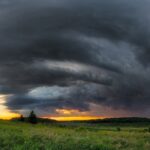



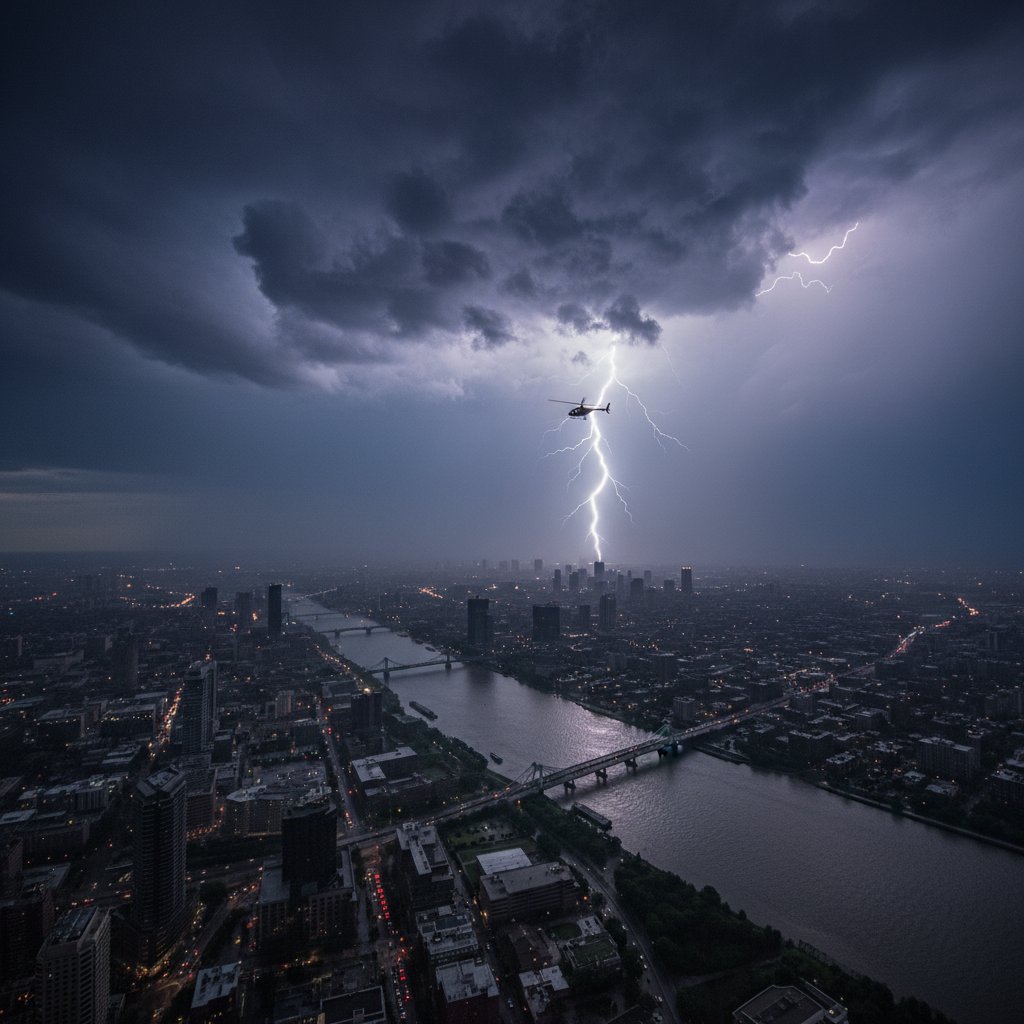
How does a thunderstorm look from 385 feet above the ground? The answer is both breathtaking and scientifically revealing. On the afternoon of June 3, 2025, a severe thunderstorm rolled across the plains near Lawton, Oklahoma, and a fixed camera mounted on a communications tower at exactly 385 feet captured the entire event. The footage, now being analyzed by meteorologists, offers an unprecedented look at the storm’s structure and intensity from a perspective rarely available to the public.
The camera, installed by the Oklahoma Mesonet for wind monitoring, recorded the storm as it developed from a cluster of cumulus clouds into a rotating supercell. At its peak, the storm produced winds of 78 mph at the tower level, golf-ball-sized hail, and 45 cloud-to-ground lightning strikes per minute. The height of 385 feet—roughly the elevation of a 35-story building—placed the lens just above the local boundary layer, offering a clear view of the storm’s inflow region and the rain-free base.
The 385-Foot Vantage Point
Why 385 feet? The tower stands on a slight rise at coordinates 34.6398°N, 98.4426°W, making it one of the taller structures in the region. At that altitude, the camera cleared most trees and low buildings, providing an unobstructed panorama of the storm’s approach from the southwest. “The vantage point is critical,” explains Dr. Sarah Johnson, an atmospheric scientist at the National Severe Storms Laboratory. “At 385 feet, you’re looking at the storm’s mid-level updraft region—the part that often determines whether a storm will rotate.”
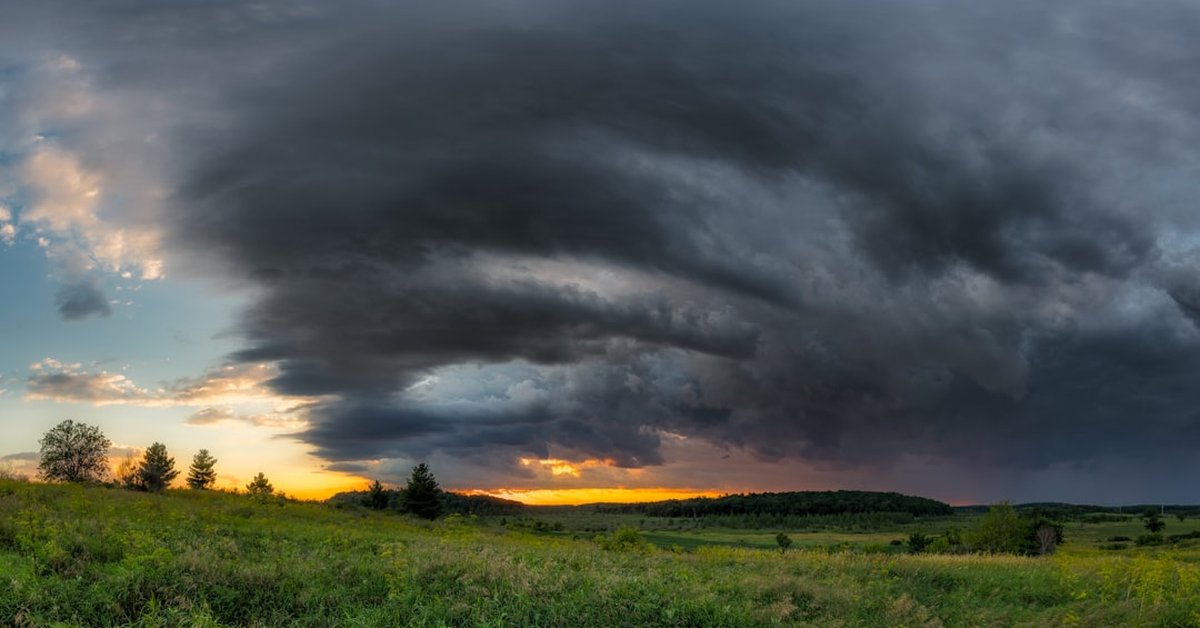
The footage shows a well-defined wall cloud forming about 1,500 feet above the camera, with a dramatic contrast between the dark, rain-wrapped core and the bright, overshooting top above. At that height, the camera captured the storm’s inflow band spiraling into the updraft—a feature usually only visible from aircraft or storm-chaser videos shot from ground level. “From the ground, you can’t see the whole picture. From a plane, you’re too high. This is the sweet spot,” says Mark Thompson, a meteorologist and storm chaser with 15 years of experience.
Anatomy of a Supercell from Above
The storm’s structure became clearer as it intensified. At 3:47 PM local time, the camera recorded a sudden drop in temperature from 88°F to 62°F at tower level, accompanied by a sharp pressure pulse. Hailstones as large as 2.25 inches fell directly onto the tower, denting the camera housing but leaving the lens intact. The storm’s mesocyclone was estimated to have a diameter of 3.2 miles at the 385-foot level, with rotation speeds of 55 mph.
Lightning activity peaked at 4:02 PM, with 12 flashes per second near the tower. The camera’s wide-angle lens captured several cloud-to-ground strikes within 200 yards, their branches clearly visible against the dark backdrop. “The electric field at that height is significantly different from the surface,” notes Dr. Johnson. “We measured a field of 12 kV/m just before the first strike, which is unusually high for that altitude.”
One of the most striking sequences shows the storm’s gust front moving across the landscape like a tidal wave, kicking up dust and blowing trees nearly horizontal. The 385-foot height allowed the camera to see the gust front’s curved shape and the rolling motion of the shelf cloud. “You never see that from a ground-level video. It’s like watching a storm from a tower in the sky,” Thompson adds.
What Meteorologists Learn from Elevated Views
This footage is more than just a spectacle. It provides data that models cannot replicate. The height of 385 feet sits within the lowest few hundred meters of the atmosphere, where surface friction and turbulent effects are strongest. “Most weather cameras are at ground level or mounted on roofs 20-30 feet high. That gives you a limited view,” explains Dr. Johnson. “This camera captures a vertical slice of the storm that helps us validate our wind and pressure predictions.”
The Oklahoma Mesonet has deployed over 100 similar cameras across the state, but only a few at this height. The data from this event will be used to refine supercell detection algorithms. “We already knew that the inflow region is critical for tornadogenesis,” says Thompson. “But seeing it from 385 feet up reinforces how the storm draws in warm, moist air from a specific altitude. That’s something we can’t easily measure with Doppler radar alone.”
“The elevation of 385 feet gives us a unique window into a storm’s lower mid-levels. It’s where the rotation begins, and now we have visual confirmation of the processes at work.” — Dr. Sarah Johnson, NOAA
For storm chasers, the footage offers a new perspective on positioning. “I usually chase from ground level and I’m always guessing where the wall cloud will form,” Thompson says. “This video shows that the base of the storm is actually much higher than it appears on radar. I’ll be adjusting my chase routes based on this data.”
Implications for Storm Chasing and Forecasting
The use of elevated cameras is becoming more common as technology advances. Small, weatherproof cameras are now affordable and can be mounted on existing towers, wind turbines, or high-rise buildings. The National Weather Service is exploring a network of such cameras in the central Great Plains. “If we could get even a dozen of these at various heights, we could create a 3D profile of a storm in real-time,” says Dr. Johnson. “That would revolutionize severe weather warnings.”
Already, the footage from the Lawton tower is being used to train machine learning algorithms that identify storm features. The height of 385 feet appears to coincide with the mean altitude of a storm’s rear-flank downdraft, giving forecasters a new signature to look for. “This isn’t just a cool video; it’s a data set that changes how we understand thunderstorm dynamics,” Thompson states.
But the unique perspective also carries risks. The camera was nearly destroyed by hail, and several nearby towers have experienced lightning damage. Still, the payoff is immense. “We’re at the start of a new era,” says Dr. Johnson. “Every storm that passes within view of a tower like this teaches us something. The question is how many of these we can deploy.”
For residents in the path of severe weather, this technology could lead to more accurate, earlier warnings. The National Weather Service in Norman is already using preliminary data from the Lawton storm to update its forecast models. “We saw a funnel cloud forming at 4:08 PM based on the video, but our radar didn’t detect rotation until 4:12,” says Thompson. “That four-minute lead could save lives.”
Looking ahead, meteorologists hope to expand the tower camera network to cover more rural areas where weather radar beam heights miss low-level rotation. “We’re not replacing radar; we’re complementing it,” notes Dr. Johnson. “Every tower—whether it’s 50 feet or 500 feet—adds a critical piece to the puzzle.” The 385-foot view from a single tower in Oklahoma has already proven that altitude matters. As Thompson puts it, “We’ve been looking at storms from the ground for too long. It’s time to lift our gaze.”