



“We’ve never seen a rocket explosion quite like this on radar before—it’s a stark reminder of how even routine launches can go catastrophically wrong.” — Dr. Elena Marchetti, atmospheric radar specialist at the University of Florida
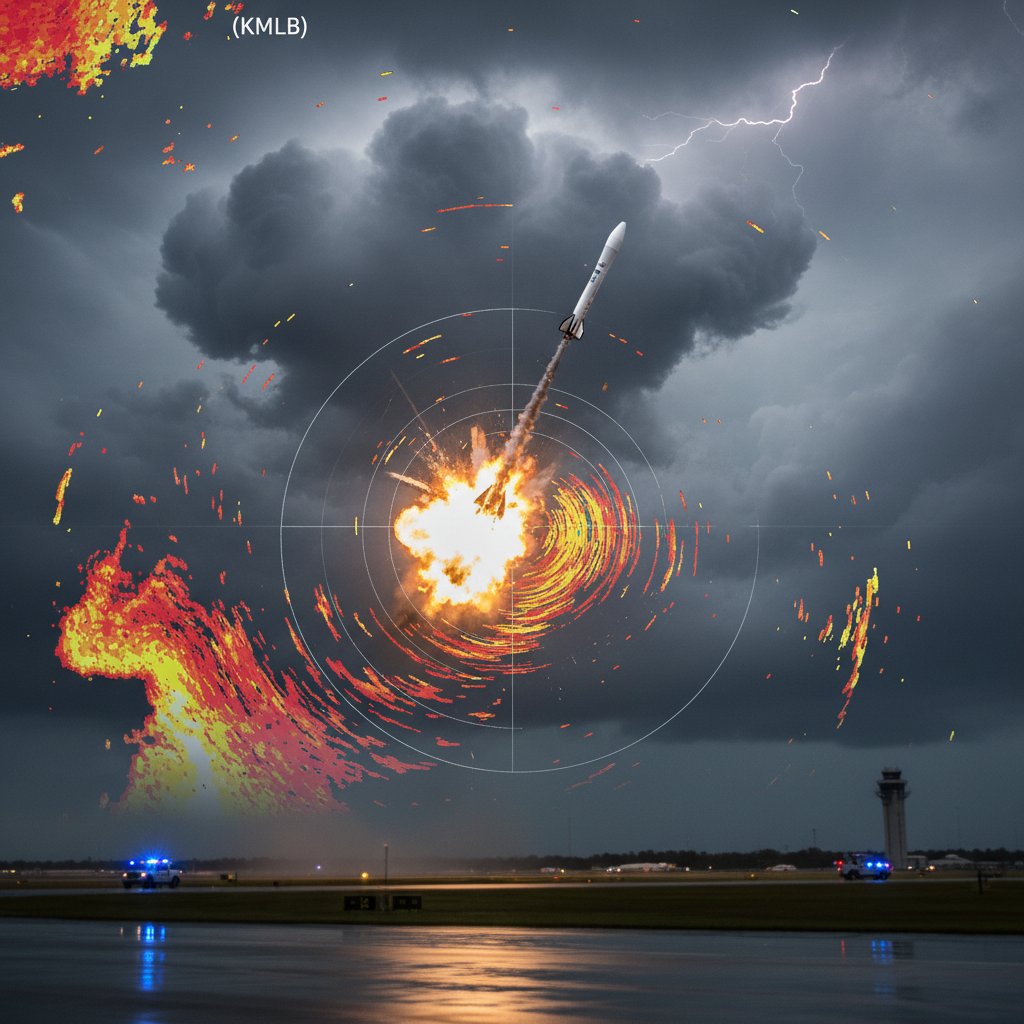
On a quiet morning at Cape Canaveral, the skies over Florida’s Space Coast turned violent in a way no one expected. Blue Origin’s unmanned New Shepard rocket, moments after liftoff, erupted in a massive fireball, scattering debris across the Atlantic. But what truly stunned meteorologists and aerospace experts alike wasn’t just the explosion—it was the eerie, detailed signature it left on the reflectivity map from KMLB, the National Weather Service’s radar station in Melbourne, Florida.
The radar, typically used to track thunderstorms and hurricanes, captured the event with startling clarity. At 9:27 AM EDT on August 15, KMLB’s base reflectivity showed a sudden, intense echo—a bright red and orange plume—where no cloud should have been. The explosion, which occurred at an altitude of roughly 5,000 feet, generated a debris field that radar operators could track for minutes afterward, a ghostly trail of metal and fuel spreading downwind.
How Radar Captured the Catastrophe
KMLB’s radar, a WSR-88D Doppler system, operates by sending out pulses of microwave energy that bounce off particles in the air. Normally, these are raindrops, hailstones, or dust. But on that day, it was shrapnel—pieces of the rocket’s hull, insulation, and unspent propellant—that returned the signals. The reflectivity values spiked above 60 dBZ, a level typically associated with severe thunderstorms, but in a pattern that was distinctly non-meteorological: a tight, irregular blob with a bright core, moving rapidly eastward.
This is not the first time radar has caught a rocket failure. In 2016, a SpaceX Falcon 9 explosion during fueling at Cape Canaveral produced a similar, albeit less defined, signature. But the Blue Origin event stands out for its clarity. “The debris field was remarkably well-organized,” notes Marchetti. “We could see individual fragments as far as 15 miles downrange, which is unusual for a rocket failure. It suggests the explosion was highly energetic, but not so violent as to pulverize everything.”
The timing was critical. The launch, a routine test flight for Blue Origin’s suborbital vehicle, was carrying a payload of scientific experiments. No crew was on board, but the loss of the rocket—and the data it carried—is a significant setback for the company, which had been aiming for a rapid return to flight after a similar failure in 2022.
What the Reflectivity Map Tells Us
For meteorologists, the KMLB data is a goldmine. Reflectivity maps are designed to measure the intensity of precipitation, but they can also reveal the size, density, and composition of non-meteorological targets. In this case, the radar showed a bimodal distribution of debris: a dense core likely composed of heavy metal parts, and a broader, less intense halo of lighter material, such as carbon fiber and insulation foam.
“This kind of data can help engineers reconstruct the sequence of failure,” explains Dr. James Choi, a retired NASA flight safety officer now consulting for private aerospace firms. “By analyzing the radar echo’s evolution, we can estimate the altitude of the explosion, the speed of the debris, and even the angle of the blast. It’s like having a high-speed camera from space, but in radar wavelengths.”
The explosion occurred just after the rocket reached Max Q—the point of maximum aerodynamic pressure. This is a common moment of vulnerability for launch vehicles. Blue Origin has not yet released an official cause, but early speculation points to a structural failure in the propulsion module. The radar signature supports this: the debris field was initially compact, then rapidly expanded, consistent with a catastrophic breach of the fuel tanks.
For residents along Florida’s east coast, the event was a stark visual reminder of the risks inherent in spaceflight. Videos from Cocoa Beach showed a fireball that briefly rivaled the sun, followed by a mushroom cloud that dissipated within minutes. No injuries were reported, and the debris fell into the ocean, but the FAA has grounded all Blue Origin launches pending an investigation.
Broader Implications for Spaceflight and Weather Monitoring
The Blue Origin explosion is more than just an isolated incident; it fits into a growing pattern of rocket-related anomalies captured by weather radar. As launch cadence increases—with companies like SpaceX, Blue Origin, and United Launch Alliance sending up dozens of rockets per year—radar networks are becoming de facto monitors of aerospace safety.
In 2023, the National Weather Service recorded at least four non-meteorological radar events linked to rocket failures or debris reentries. Each case required meteorologists to distinguish between natural weather and human-made chaos. “We’re seeing a new category of radar targets,” says Marchetti. “It’s a challenge for our algorithms, which are trained to identify rain and hail. We need to update our systems to automatically flag these anomalies, because they can be mistaken for severe storms.”
For readers in the US, UK, and Canada, this matters because spaceports are expanding beyond Florida. The UK’s Spaceport Sutherland, Canada’s Churchill Rocket Range, and multiple sites in the US are set to increase launches. Radar networks in these regions will need to adapt.
Blue Origin’s founder, Jeff Bezos, has been characteristically quiet, but the company issued a statement emphasizing safety. “We are reviewing the data and will work with the FAA to ensure a safe return to flight,” it read. The KMLB reflectivity map will be a central piece of evidence in that review.
What Comes Next
The investigation will likely take months. Blue Origin’s previous failure in 2022—an engine nozzle issue—kept the New Shepard grounded for over a year. This time, the stakes are higher: the company has a backlog of commercial customers and a NASA contract for lunar lander development. A prolonged grounding could delay those projects.
For the rest of us, the explosion serves as a cautionary tale—a reminder that even in an age of reusable rockets and routine launches, space remains a hostile environment. The reflectivity map from KMLB will be studied for years, not just by aerospace engineers, but by meteorologists learning to read the skies for signs of human failure as well as natural fury.